
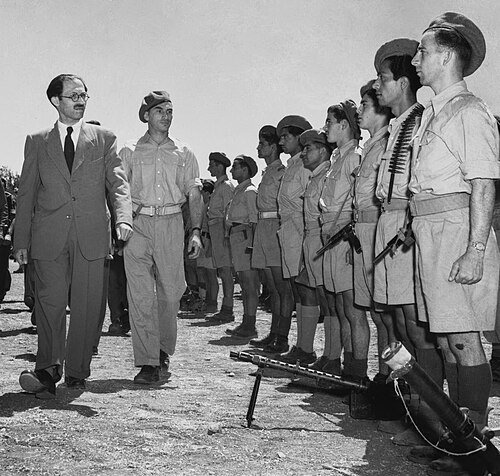
(* the following is a fictional reconstruction of events)
The Massacre at Deir Yassin - ‘Proud, generous and cruel’i
They lie on their bellies in the starlit valley. They are angry young men, members of the Irgun group. They are poorly trained, barely out of their teens. Even the commander is youthful. Their leaders are Jewish zealots who have turned against both the British, and their former Haganah leaders. For them, abandoning the homeland they believe God has given them here in the Promised Land is unthinkable.
The Zionists are troubled by recent Arab successes; the enemy has won control of parts of the main road between Jerusalem and Tel Aviv. Supply convoys are subject to regular shelling. Jerusalem is a city under siege. In an effort to break the siege the Haganah has attacked another strategic village close by. Tonight it is the turn of the Irgun. It is their first operation; their leaders are keen to demonstrate the group’s prowess.
The young men know the village; it has been the subject of frequent battles for months now. But the peace treaty they signed with the village barely two weeks ago has been abandoned in the excitement of planning the attack. All they know is that at an altitude of 800m, the village of Deir Yassin occupies a commanding location above the critical road.
The few dwellings which make up the village sit firmly astride the hill. They shelter between a scattering of tall pine trees which shade them during the heat of the day. The fields and olive groves below have afforded the occupants and their ancestors a meagre existence for centuries.
The fighters start up the steep hill, crawling laboriously through the scrub. They have the double advantage of surprise and an approach from the darkness of the valley. As the day lightens above, they can see the silhouettes of the villagers, starting their day, lighting bread ovens, marshalling families.
A dry stone wall looms at the edge of a grove of ancient, twisted olive trees. They are close now. The sound of barking; the village’s dogs are alerted. The figures above them stiffen, start to peer down into the valley. Voices raised in alarm. The young men scrabble the rifles from their backs.
A voice calls in the darkness nearby: “Mahmoud? Is it you?”
It sounds like the password; A familiar challenge. One of their number responds automatically.
“Lohemet! Warrior!”
It is an easy mistake, but one he will rue until he is an old, old man. There is no longer any doubt as to their presence; shots ring out. He hears the sharp crack of the bullets, feels the impact in the ground on which he and his comrades still lie. He fires aimlessly at the buildings barely 50 metres above, his heart beating a staccato rhythm in his chest. A light machine gun chatters somewhere to the left of him, prompting the invaders to surge forwards. He scrambles to his feet and follows.
They gain the cover of the first buildings. In the cover of the low structures they pause, panting, resting their backs against the uneven wall, gathering themselves. Opposite, a harnessed donkey stands beneath a barred window, observing them placidly.
Some distance away, the Mukhtar’s1 house rises commandingly above the village. The sniper occupying an upper window is a fine shot. Turning a corner, the commander takes a bullet through his knee. Grimacing with pain, he hauls himself back into cover, leans his head for a moment against the wall. Closes his eyes. Then he shouts above the sounds of the battle:
“Men, remember that today there are no holds barred.” The pain from his leg is growing quickly. “Remember our mission – blow as many houses as you can, kill anyone who shoots at you. Anyone…”
The men need no encouragement; the blood lust, a killing rage is upon them. Later, the leering, glassy eyes of his comrades, and the numbness that carried them through the events of that day and the next, will linger burning in his memory.
He darts forward, gains the relative security of the first house. The door is fashioned roughly from old wood, many times painted. With his rifle butt he smashes at the lock. Once, twice and the flimsy door swings wide. A woman stands inside, she clutches her child tightly to her. Even today he remembers, as vividly as were it this morning, the terrified eyes fixed on his, and the slow motion grenade rolling towards her feet.
He ducks back into the street. The noise seems louder than he remembers. He pauses a few seconds to recover, then rushes the door, roaring with fury, or fear. Nowadays he cannot remember. Beside him another, in his hands a sub-machine gun. The reports of its bullets merging into one continuous rattle.
When it is over, when the excitement subsides and the adrenalin has receded, he stands in the silence, the smoke still drifting in the air, observing the bodies, the blood. Shattered furniture, the remains of the family he has destroyed. Parents, children, grandparents, all collapsed in various attitudes where bullets or shrapnel have caught them.
The stench of blood assails him. he goes back outside to retch onto the dry dust of the street. But there is no time for rest. Time to move on to the house next door. His comrades have been there already. On a bed an elderly woman is sitting. She is dead, shot through the chest. Blood pools around her. Nearby, on a chair, slumps another woman. She has been beheaded. A small noise; it comes from beneath the bed. Cautiously, he bends to look. Huddled there, in the furthest corner, is a girl, perhaps four or five, her whole body shaking. Her still, wide eyes meet his in a look of abject terror. Quickly he straightens, leaves the house. He is profoundly shocked by the image of what was in that ruined house, rocked by the full realisation of what has happened. She could have been his own sister. To this day he wonders what became of the girl; in the dark recesses of his mind her tiny, terrified face stares at him still.
But there is little time to think. He is caught up in the rush of his comrades as they move from house to house, exploding, killing, destroying. House by house they move through the village, slaughtering without mercy.
Much later, when they are done, they sit in exhausted groups, wordless and horrified by their own actions.
Then it is time for the prisoners. The commander, his leg bandaged , leaning awkwardly on a bench against a wall, barks: “Round them up.”
Men, women and children are kicked and pushed into a line in front of a house. Most are silent, defeated. One or two still stand tall. A middle aged man, taller than the rest, shouts at their captors, accusing them of cowardice, waving his fists, spitting. After a time one of the men strides over and hits him full in the face with his rifle butt. He falls motionless to the ground.
The commander is visibly angered. “Take him.” He orders.
They drag the unconscious man to an olive tree and tie him to it using a length of rope lying nearby. He regains consciousness as the last knots are tied, loudly resuming his protest, fighting the bonds which hold him. The commander hauls himself upright, drags himself painfully to stand in front of the struggling captive. In terrified silence, the Arabs look on.
“This will teach you to spit at the Jews,” he growls. Then he turns to his subordinates and mutters an order.
“Burn him,” he says2, “And shoot these,” he adds, with a gesture of dismissal at the line of captives.
Later still senior officers from the Haganah arrive. They pace nervously around the village, their faces registering first horror, then concern. They are worried, anxious that news of the massacre does not spread. The problem is the bodies. Dozens are piled in locations around the village.
The decision is taken after much heated discussion. The bodies must be burnt. Gasoline is sent for. The fighters empty the metal cans of fuel over the piles, light them, step back, awkwardly watching as the flames take root. The clothes burn first, the whoosh of ignition takes care of them. The flesh takes longer the stench is overpowering. Many of the fighters vomit. It is hard to breathe.
Small groups of surviving Arabs, spared by chance or pity, or simple fatigue, sit quietly on the ground or lean against each other in attitudes of exhaustion. Most are women and children, one or two are pregnant, others hug small children to their breasts, keening pitifully, fearful for their fate, most still numbed by the shock of what has happened. The Haganah officers decide they must be taken to Jerusalem for others to decide what to do with them. They are quickly loaded onto trucks and disappear along the rutted track into the gathering dusk.
Much later, when the fires have died, and the terrible odour still hangs in the air, they find that the corpses are barely diminished. And then, as if in protest, one after another the bodies bloat, their limbs straightening with rigor mortis as if they are characters in a ghastly play.
Horrified, the Haganah officers send for others to bury the remains. The helpers prove to be members of the youth corps; 17 year olds to bury the bodies.
The young man leans exhausted against a wall. He feels empty. A part of him has broken. Later, in interviews with youthful Israelis seeking the truth of the massacre, he will struggle to recall details of that horrific day. He will smile meekly, shrugging off the guilt with the words of his officers; the justification that there was no choice. Already the mind’s self-preservation system is deleting the worst of the images. The departure of the adrenalin has left him clear headed, lucid. He can hardly believe what he has been a part of ii.
April 9th 1948. Great Britain has been administering the League of Nations’ Mandate for Palestine for nearly a quarter of a century. Lord Arthur Balfour’s 1917 declaration of support for a Jewish homeland, to be staked out in the biblical “Promised Land” of Palestine is a distant memory.
Palestine is in open revolt. Jewish extremist organisations like the Haganah, Irgun and the Stern Gang3 are engaged in a violent struggle against their former sponsors. They are determined to gain full control of their new homeland and angered by Britain’s opposition to the growing wave of Jewish immigration. Arabs, under the talented leadership of Abd al Qadr al Husayni are enthusiastically resisting the Jewish occupiers.
The kind of simple Palestinians who constitute most of the region’s population are making desperate efforts to continue with their lives but in the eyes of the Jewish settlers of the day they are, quite simply, in the way.
The massacre at Deir Yassin left some 110 dead, although these numbers remain disputed. Various media outlets at the time described widespread rape and abuse despite having little supporting evidence. Nevertheless, the rumours were sufficient. The massacre is said to have provoked the flight of some 250,000 Arabs. They were to be the first of some 750,000 Palestinians to leave in what has become known as the “Nakba” – the catastrophe.
But this was not the only such massacre.
On 31 December 1947, Haganah fighters attacked the village of Balad al Sheikh, east of Haifa. An elite force of the Haganah’s Palmach4 unit had orders to kill as many adult males as possible. It blew up many houses and killed as many as 70iii. In the aftermath, most of the villagers fled and within a few short months Zionist forces had occupied the village.iv
Barely six weeks later, on 15 February 1948, the northern Palestinian village of Sa’sa’v was attacked in similar fashion. Dozens were killed and by October the village had been effectively depopulated.
Then in October of the same year the Israeli army’s 7th Brigade reportedly attacked the village of Saliha,vi in the upper Galilee, a few kilometres from Sa’sa. Soldiers destroyed a building there, killing nearly 100 Palestinians sheltering inside.
In July 1948, arguably the most infamous massacre occurred in the cities of Lydda and Ramla, both strategically located at the intersection of Palestine’s main north-south and east-west routes, near the main railway station and what is now Ben Gurion Airport. Jerusalem’s main water source was just a few kilometres away.
The Israeli Air Force initiated the action with an aerial bombing campaign. The subsequent arrival of Colonel Moshe Dayan’s 89th (Armoured) Battalion saw a column of vehicles indiscriminately firing machine guns, setting off panic and taking dozens of lives. The sudden arrival of a small number of armoured vehicles belonging to the Arab Legion sparked even heavier exchanges. Poorly trained Israeli soldiers panicked, threw grenades into private houses and were given orders to shoot at any clear target. Yitzhak Rabin, the battalion’s operations officer, issued an order: “The inhabitants of Lydda must be expelled quickly, without regard to age.”vii
There is confusion over the numbers killed at Lydda and Ramla. Various historians estimate them to be between 200 and 400. There were more accusations of robbery and rape. What is not disputed is that up to 70,000 people – the populations of both cities – were forced to embark on a lengthy exodus during an intense heatwave. It took those who survived the expulsion three days to reach the small town of Ramallah using transport provided by the Arab Legion.
*
Plan Dalet
These events were part of a deliberate strategy known as “Plan Dalet”, the brainchild of David Ben Gurion, later to be the first prime Minister of Israel. It called for the mounting of operations against enemy population centres inside or near the Jewish defensive system to prevent active armed forces from using them as bases.
The Plan divided operations into three stages: (1) destruction of villages (including setting fire to, blowing up, and planting mines in the debris), especially those deemed to be difficult to control; (2) search and control operations involving the encirclement and search of villages; (3) in the event of resistance, destruction of any armed forces encountered and expulsion of the civilian population to outside the borders of the new state of Israelviii.
The Haganah launched Operation Dalet in early April 1948. In the hands of poorly trained, mostly youthful volunteers, expulsions soon became systematic and violent.
After the formal establishment of the State of Israel on 14 May 1948, the new government set up a body called the “Transfer Committee” tasked with overseeing either the destruction of Palestinian towns and villages, or their repopulation with Jews.ix The Committee’s efforts led to around 400 Palestinian settlements being destroyed to prevent their displaced occupants from returning. Many more were simply repopulated with Israeli Jews. The former Palestinian residents, many of them having lived on properties their families had owned for generations, fled to Lebanon and Jordan and other neighbouring countries, where some 7 million people, including descendants, still live in vast refugee camps.x,xi
In his account of the 1948 war, The Revolt, Menachem Begin. then head of the Irgun group, wrote: "The massacre was not only justified, but there would not have been the state of Israel without the victory of Deir Yassin.xii ”
So What?
There is little doubt that the attacks on Palestinians under Operation Dalet, especially the massacre at Deir Yassin and the rumoured sexual assaults of Arab women in particular, precipitated an enormous exodus from Palestine. This strategic depopulation was at the heart of the Nakba which is, to all intents and purposes, the root cause of Israel’s conflict today.
TeYitzhak Rabin, Moshe Dayan, David Ben Gurion, Menachem Begin: three future prime ministers and one future defence minister. These are the heroes of Israeli history. They bestrode the global stage and built modern day Israel. These were men who played significant roles in the removal of countless Palestinians through massacre and destruction, all to make way for a Jewish state. The purported threat to Israeli lives and the higher goal of achieving the Promised Land was their justification. It was a strikingly effective tactic.
Doesn’t it somehow sound familiar? It is an uncomfortable possibility that Israeli planners, faced with similarly wicked problems today, may be looking to their own history for inspiration…and justification.
Yours sincerely,