
The boy peers through the cracked window glass, straining in the half-light of early morning to see the Israeli soldiers below. He lives in a tall, decrepit building in the centre of the West Bank refugee camp in Jenin. The window was damaged in another attack two days ago. His worn, patched clothes are clean, courtesy of his hard-working mother. His whip-thin frame is starting to show the signs of adolescence. Outside the rain which turns the dusty streets to dark mud is unusual. Winter is not far off.
The flat crack-whip of rifle fire fills the air, punctuated by the heavier sounds of explosions, answering bursts of machine gun fire. Above him the ceaseless deep buzzing of the drones. He barely hears them; they are always overhead, intimidating the people of the camp with their long lenses and the menace of their missiles. His eyes are not frightened, despite his youth. In the camp, this sort of violence is normality.
A huge Israeli bulldozer crawls along the street, pushing the road surface before it with inexorable determination. In its gaping jaws a small car judders and twists, caught up in a maelstrom of pipes and cables, rubble and torn wood. The boy can just make out the ‘dozer driver’s white face. Fleetingly, he thinks he recognises his own brother in the pale features, just as quickly discards the notion. His brother was killed a month ago. Old enough to carry a weapon, he was caught in the explosion of a tank round fired at a mosque. A mosque sheltering the entrance to the tunnel they were to use for their escape. There was little left to bury. The memory still hurts. He rubs his forehead, returns his gaze to the street below.
Behind the ‘dozer, armoured vehicles follow with troops, lots of troops. The boy sighs quietly. He knows it will be weeks before the power and water supplies the ‘dozer has destroyed are restored. Drink is in desperately short supply as it is.
Night after night, they raid the camp. Bulldozers, troops, armoured vehicles fill the streets. Sometimes their jets strike targets, or their drones release missiles. Seemingly indiscriminate attacks causing untold damage.
Barely a week before, fighters belonging to local groups used a huge IED2 to destroy an Israeli armoured vehicle. It was known that the occupiers would return, they always did. The fighters had worked around the clock to prepare for the coming battle. Building explosives, readying tunnels with men and equipment and preparing ambush positions. Everyone recognised that the struggle was futile. But they also knew that the struggle was their identity. An implacable refusal to give in drove them; a conviction that in the struggle lay the seeds of victory. That one day the refugees would return, the lands of their forefathers would be restored, and the oppressor would be consigned to history, of that there was no doubt. It was simply a matter of time….
Palestinians have been living with their families in the Jenin refugee camp since the 1950s, when Israel’s Jewish militias forced them from their homes in Haifa. They’ve been there ever since, witness to numerous battles and near-continuous violence. Not to mention displacement. Most have lost family members or friends to the raids. Many remember the destruction of the camp during the second Intifada, when thousands were forced to flee the devastation of the Israeli bulldozers. Eyes brighten when locals recount how the fighters had sown every street and every building with explosives.
In Jenin, violence is commonplace, an everyday fact of life.
The younger generation has no expectation of work. Their absorption into the ranks of local militant groups is an inevitability. The groups are popular in the community; they supply a semblance of law and order where the Palestinian security forces cannot. Or will not. Small wonder the Palestinian government’s authority is non-existent. Sometimes the groups are the only source of food. They muster under the banner of local families, or of ancient clans whose affiliations run far deeper than those of Hamas or Fatah. The opportunity to carry the weapons smuggled from Jordan and Israel is too much to resist. The weapons confer status, a role in defence of the local population and a chance for revenge. Some of the fighters who join come with the pedigree of membership of other groups. They are an object of emulation among the younger men; a source of wisdom, of stirring stories of actions against the oppressor.
Since 2018, when the Palestinian Authority (PA) began to lose its funding along with its legitimacy, violence in the cities of Area A3 has been rising. The PA’s security forces, faced with the dilemma of defending Palestinians against Israeli raids or acting as Israel’s security sub-contractor decided wisely against confronting Palestinian militancy, preferring to allow the Israeli army to clean up after itself.
As a result, since the early 2022 launch of Israel’s “Operation Break the Wave”, cities like Jenin, Nablus and Tulkarm in the West Bank have been subject to near nightly raids by Israel’s army. Since 7 October 2023, these have accelerated to around 200 raids per week, with more than 230 Palestinians killed, including 62 children, and well over 3,000 detained, many without chargei. In late 2023, in evidence that resistance is reaching deeper than merely local groups, the IDF arrested the secretary general of the ruling Fatah party in Jenin on charges of funding and inciting terrorismii.
Further evidence of the spread of disaffection among the Palestinian security officers who have been detained or killed in Israeli raidsiii, and Fatah’s own social media channels, which boast of those from its own ranks who have lost their lives or been imprisoned in the resistance against Israeliv.
In area C, where Israel has full control, there is little in the way of respite from its persecution. Among the 300,000 Palestinian farmers who eke a precarious living from ancient olive groves, matters are, if anything, worse than in the cities.
Israeli military and civilian leaders have always regarded the high ground of the West Bank as a threat to Israel’s narrow central belt. Efforts to settle these heights with Jewish communities have sought to deny these strategic areas to Israel’s adversaries.
The Netanyahu government has promoted the building of record numbers of new settlement units. Despite their blatant illegality in the eyes of the international community. Settlers now number around 700,000, an increase of over 30% since 2012, and a formidable force on the groundv. The appointment of a civilian minister – Finance Minister Bezalel Smotrich – as arbiter of civilian life in the West Bank removes any pretence that these settlements are permissible under what the Israelis choose to regard as the military law of occupation.
West Bank Palestinians are forced to struggle for even the most basic necessities. Access to water for residents is based on an agreement signed between Israel and the PLO in 1995 and intended to remain effective for five years. In fact, the agreement remains in force, ignoring the 75% growth in the Palestinian population. Palestinians are forced to purchase water from Israel at high prices, and distribution is hit-and-miss. Israelis benefit from three times the amount of water available to Palestinians who are forced to store water in rooftop containers, and even these the civil planning authorities are reluctant approvevi.
Using violence in Gaza as an excuse, regular settler attacks against Palestinians have gathered pace. Attacks, which prior to 7 October 2023 averaged around 30 weekly, have surged to nearly 100 per week. Full-throated support from certain ministers has compounded the problem. Settlers are being publicly encouraged to take care of their own security, with government issuing 10,000 firearms as well as body armour and helmetsvii. The deployment of active-duty soldiers to Gaza has left the ranks of IDF security forces in the West Bank charged with settler reservists whose motives and discipline look increasingly suspectviii.
Attacks include intimidation and threats, outright violence and destruction of property, deliberate occupation of farming land and theft of livestock. Many are filmed and circulated provocatively on social media.
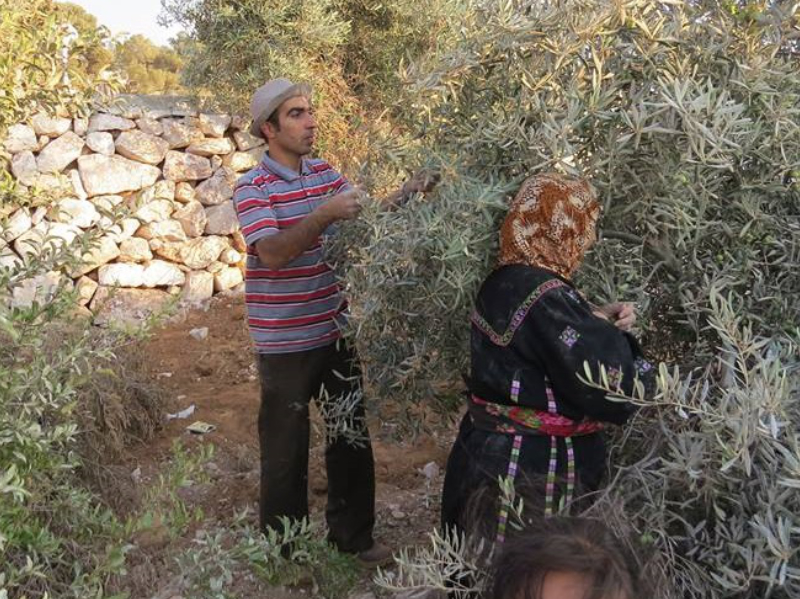
Since 7 October, a key target has been the olive harvest. Traditionally collected during October and November, this is an important source of income for those living in the West Bank. Trees have been uprooted and burnt and farmers prevented from reaching their groves. Israeli Finance Minister Bezalel Smotrich has even called for a “Palestinian-free buffer zone” to be maintained around settlementsix.
Between a quarter and a third of the population of the West Bank is thought to have been affected by the failure to collect the harvestx. Perhaps more importantly, the trees are integral to Palestinian identity, connecting the people with their land.
As a result, over 1,300 Palestinians from more than a dozen communities have fled in recent weeks.
So what?
Israel and its leaders demonstrate time and again their inability to think strategically. The government’s focus on short-term operational activity on all of its borders has become its ruling mindset. Comments and actions from members of the coalition government which provoke Palestinians are likely a deliberate means of inciting violence, intended to justify tighter security control and greater restrictions imposed on Palestinian livelihoods. Thereby encouraging flight and facilitating annexation.
An example is the IDF’s accelerated campaign of night-time raids against West Bank cities. This almost certainly seeks the detention of Hamas-affiliated personnel and potential leaders in order to limit opportunities for wider violence.
However, this is likely having the opposite effect. Impoverished Palestinians who have lost hope, identity, and livelihoods as a result of Israel’s policies in the West Bank are angered and desperate. Settler violence and the war in Gaza, amplified by social media and supported by public rhetoric from government ministers, has almost certainly provided Palestinians – as well as their own security forces and political bodies – with a unifying grievance against Israel. The collapse in effective leadership from the PA, as well as non-payment of salaries to security officers highly likely sets conditions for more widespread violence.
At best, West Bank Palestinians face an uncertain future. At worst, their future will continue to be defined by oppression, impoverishment and loss of identity.
Outrage at Israel’s attacks in Gaza and the loss of family members and friends, together with the collapse of effective leadership and security provision by the PA, supplies an opportunity for malign actors to establish themselves, support recruitment and coordinate militant activity.
Palestinian President Mahmoud Abbas is elderly and infirm. His ultimate demise will likely provide cause for further instability as potential successors mobilise armed supporters in a competition for succession.
Fixed by events on two of its borders and faced with escalating instability, it is highly likely that Israel will bolster its forces deployed in the West Bank to improve security control and secure its monopoly of violence. It is also likely that Israel will thereby continue its entrenched policy of rendering the West Bank unattractive to Palestinians, encouraging population displacement and facilitating annexation.
In the current circumstances, it is unlikely that any new Israeli government will adopt markedly different policies towards the West Bank. It is equally unlikely that neighbouring Arab states have the stomach or the financial or military resources to offer or implement an alternative solution.
So…the real question is whether the international community will again turn a Nelsonian blind eye to events that it is strangely reluctant to oppose.
Yours sincerely,