
Ayatollah Sayyed Muhammad Hussein Fadlallah
Ayatollah Sayyed Muhammad Hussein Fadlallah was raised and educated in Najaf, Iraq. He studied alongside Sayyed Baqr al Sadr, collaborating with him on a journal at the same time as Baqr’s founding of Hizb al Dawa. His family were wealthy Lebanese, from Aynata in Southern Lebanon. When he arrived in 1966, Lebanon’s consociational democracy provided an attractive platform for his ideas.
Unlike Sadr, Fadlallah in common with many believed that the obstacle to Shi’a independence was Imperialism. His was a deliberately socially aware version of Islam and a pan-‘Muslim’ approach which competed with Nasser’s secular pan-‘Arab’ rhetoric, arguing that only a unified Islamic struggle could liberate Palestine, maintaining that if the Sadr’s Shi’a simply opted out they would be victimised. The disenchanted young found the message appealing.
Fadlallah based himself in Nabaa, East Beirut, a shantytown made up of Palestinian refugees mixed with poor young Shi’a. He opened a Husayniyya, established a social association to supervise clinics and youth clubs and founded a middle school for Islamic studies. The young occupants of Nabaa proved a receptive audience; Fadlallah’s regular sermons and talks addressed the matters that concerned them. He urged them away from secularism in favour of Islam. His natural ecumenicalism extended his appeal to the Sunni and he quickly began to develop a following, although it was not until the advent of civil war in 1975 that his leadership moved out of the shadows.
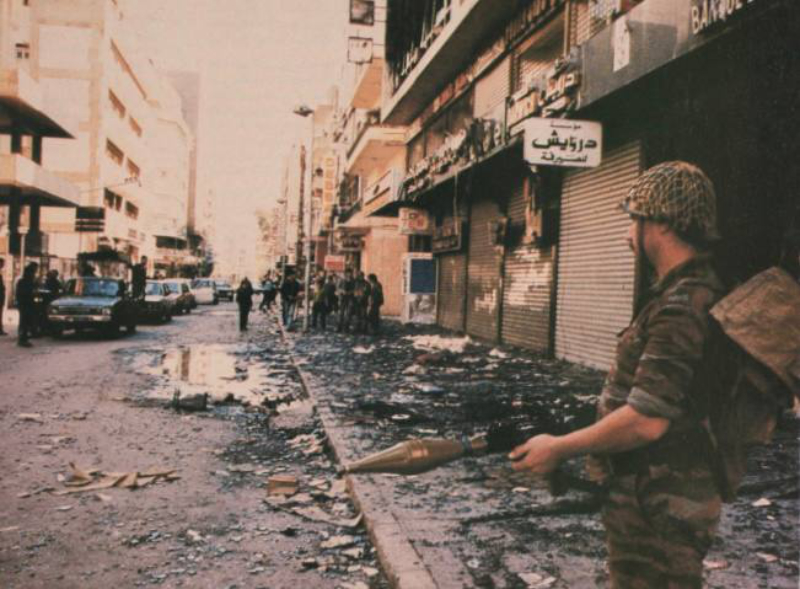
1976. East Beirut. Israeli supported Christian Phalangist Militias attack Palestinian forces.
In 1976, government Phalangist militias backed by Israel attacked Palestinian forces in eastern Beirut.
Nabaa was besieged and subjected to heavy shelling. The Palestinians demanded Shi’a’s solidarity, presenting the same dilemma as the southern Shi’a had faced under Israel’s bombs.
Imam Sadr, fearing for his people’s fate, used his relationship with the Phalangists to obtain safe passage for the Shi’a, leaving the Phalangists to crush the Palestinian forces.
The agreement was seen as a betrayal. Fadlallah, as one of the evacuees who had suffered the worst excesses of the siege himself, grew in stature. The text he authored during the siege “Al Islam wa mantiq al Quwwa” - Islam and the Logic of Power was seminal.
In it Fadlallah argued that Islam could defeat aggressive imperialism using force. He claimed that western military superiority could be countered by sacrifice and the setting aside of fear and provided a religious justification for “self-martyrdom”, explaining that suicide operations as part of a war deemed legitimate under Islam were legitimate.
It provided the intellectual basis for the abandonment of traditional Shi’a quietism for a doctrine based on rebellious force. The text was well received; many were already admirers of Ali Shariati whose revolutionary ideas at the Hosseiniye Ershad Institute in Tehran had rendered him unpopular with the Shah.
Yours sincerely,