
Iran’s growing Hegemony
Hezbollah’s brief war with Israel in 2006 provided further affirmation of Iran’s growing hegemonic power. The conflict was interpreted on the Arab street as proof that an Iranian backed Arab nationalist movement was capable of holding even powerful Israel to account. The Arab states, observing with some concern the emergence of this new, robust “Shi’a Crescent” between Tehran and Lebanon, worried that it might, for the first time for a millenia, pose a threat to their security.28
In neighbouring Syria Soleimani’s strategy was to bear further fruit. Support for Bashir Al Assad’s Allawite regime had intensified with the advent of 2011’s civil war. Quds Force operators perfected a strategy of deploying small numbers of conventional forces in expeditionary units to link up with and command militias on the battlefield. Direct war fighting responsibility was outsourced to Hizballah, Iraqi Shia Militias and Shia mercenaries from Afghanistan and Pakistan, demonstrably deterring both regional and international powers from entering a protracted ground conflict which might have had ramified consequences for Iran.29
Iran was now able to significantly expand its regional influence. Israel’s regional freedom of manoeuvre had been constrained by increasingly competent Shi’a militia groups and the military capabilities of Lebanese Hizballah were greatly strengthened by land shipments of precision guided missiles through territories in Iraq and Syria now controlled by the Quds Force.
Within Iran itself, this deterrence strategy was reinforced by anti-access and area denial strategies using fixed and mobile air defence systems, artillery and ballistic missiles as well as electronic and cyber warfare alongside specialist naval units tasked with inflicting considerable cost on adversaries in the event of war.30 In addition, investments in surface to surface ballistic and cruise missile capabilities allowed targeting of western and regional military bases, ships and aircraft and the delivery of a range of anti-access operations including numerous destabilising close encounters which have, despite the inevitable threats of retaliation, deterred any form of substantive attack on the Iranian land mass.31
But from the broader perspective, the regional deterrence strategy alone was insufficient. The difficulty was US determination to ignore the established rules based international order, in its illegal invasion of Iraq and the clear risk that Iran was next. To the Iranian leadership, regime survival depended on the development of a nuclear deterrent.32
The Nuclear question
Iran’s interest in nuclear energy extends as far back as the late 1950’s and Eisenhower’s “Atoms for peace” policy. But apart from a “modest” reactor in the University of Tehran, shut down for lack of adequately qualified staff in 1969, and a flirtation with Britain over a possible joint venture in the field in the late 1970’s,33 little progress was made in this field until the Revolutionary government, having initially dismissed the technology, quietly restarted Iran’s nuclear programme in 1984.34
A $7billion arms deal with Russia in October 2001 illustrated the depth of Khatami’s frustration with the west’s rebuttal of his attempts at reconciliation. The delivery of a Russian nuclear reactor for Iran’s Bushehr power plant and successful tests of Iran’s Shabab missiles followed in May 2002.35 But Iran maintained that its intent was peaceful and backed this with an early sign up to 1970’s Nuclear Non-proliferation treaty (NPT) as well as the Biological Weapons Convention and the Chemical Weapons Convention.36 That inspectors from the International Atomic Energy Agency (IAEA) seemed perpetually unable to identify evidence of wrongdoing placed the west in a difficult position.37 And then in 2002, to the west’s enormous consternation, Iran revealed that its nuclear programme was more advanced than had previously been thought, implying it had breached NPT conditions.38 Hard on the heels of Bush’s Axis of Evil speech, the West’s concern was palpable.
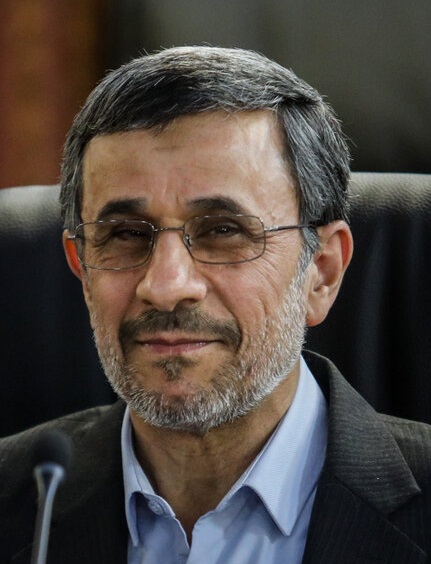
The arrival, in 2005, of President Mahmoud Ahmadinejad accelerated tensions. Ahmadinejad was outspoken and overtly antagonistic to the US – the “Great Satan” – and Israel, the “Little Satan”. He wasted no time in reinforcing his commitment to the direction of travel internationally. Some 40 ambassadors and senior diplomats were immediately withdrawn from their positions in embassies across the west39 and the President happily took every opportunity to sow further confusion in the ranks of his opponents with provocative actions and statements that expressed an overt disrespect and hostility to the west and its culture and confounded its representatives. He was also at pains to brandish the success of Iran’s nuclear programme.
His behaviour was catnip to a frustrated domestic audience and when the US National intelligence Estimate concluded in 2007 that Iran had in fact ceased weaponisation efforts in 2003 it was clear that the President’s strategy had paid off, at least in so far as the US had apparently lost the appetite for further confrontation in the Middle East after the debacle of Iraq.40
The West starts to take Iran seriously
Where Khatami’s “dialogue of civilisations” had failed, the new strategy of regional instability, complemented by Iran’s growing nuclear ambitions, had at last forced the international community to take Iran seriously.
In America, fears that Iran could develop nuclear weapons from its domestic power generation programmes meant that preventing Iran from acquiring any form of nuclear equipment would quickly become a foreign policy priority.41 Iran now had something the west – especially the US – feared; the ability to enrich uranium. Something that had become, in Ansari’s words, a matter of “national principle”. Iran finally had a seat at the table.
In the end it was President Ahmadinejad, re-elected in in transparently rigged polls in 2009, and his hubristic and frankly irrational inability to manage Iran’s newfound international status that interrupted its momentum.
The ebb and flow of sanctions of various types to which Iran had been subject since 1979 had been effectively cushioned by the some $800billion of oil revenue that flowed into the country between 2005 and 2013.42 By 2015, however, Ahmadinejad’s serial mishandling of international attempts to bring resolution to the nuclear position had goaded an increasingly united West, including Russia and China, into imposing sweeping sanctions on Iran, including injurious measures to constrain the very oil exports which had previously permissioned Ahmadinejad’s wild gyrations on the global stage. Before long Iran was buckling under the strain and in the end President Khamenei himself decided to pursue efforts to break the impasse and relieve the pressure on Iran’s increasingly impoverished people.
Such was the background to the Joint Comprehensive Plan of Action (JCPOA) steered by Ahmadinejad’s new president Rouhani and given divine sanction by Khamenei himself. It marked what would prove to be a temporary end to the nuclear debacle and, in its detail – arguably the fault of inexperienced Iranian negotiators43 - seemed to do more for western agendas than it did for hungry Iranians.
It is hard not to regard the conclusion of the JCPOA in the wider context as the culmination of a process of restoring Iran to the position of respect on the global and regional stage it had long sought. After all, the Revolutionary government had survived for nearly four decades. It had successfully deterred invasion by powerful western adversaries and its regional influence had grown beyond recognition. It was powerfully entrenched on Israel’s borders and Iranian proxies were increasingly influential in Syria, Iraq and even in distant Yemen. Most importantly its calibrated nuclear strategy had forced the world’s great powers to its table.
In the ensuing decade the world would witness Iran move from strength to strength, navigating western military threats and international opprobrium to a position of ever greater influence with consummate skill. Indeed it is only in the last months that its rise has finally been arrested by the determined actions of Israel, with the support of the west and in flagrant disobedience to the rule of international law. Negotiations in hand today between the regime and America’s latest president, Donald Trump, may yet supply the basis for a peaceful solution but seem more likely to bring a belligerent Israel’s considerable military power to bear on Iran’s nuclear programme in a final decisive act that may yet herald a new conflict in the wider Middle East.
Conclusion
Iran’s centuries old history of Imperial dominance casts a long shadow on recent history. The collapse of the impecunious Qajar monarchy amid the throes of rebellion a hundred years ago marked the commencement of efforts to recover past glories but it was clear that Iran’s parlous domestic situation would first need to be recovered. Shah Reza Pahlavi, a decent fit in the role of enlightened despot, successfully reunited the divided country and made progress in the direction of the unity and administrative capability it needed to qualify on the international stage. But it was to be his son, Mohammed Reza who would steer the country to regional and international prominence as the “Gendarme of the Gulf”. But. despite huge US support, Reza Shah proved ultimately ill-equipped to withstand Ayatollah Khomeini and the revolutionary fervour of the 70’s.
In its turn, the Islamic Revolution was not short of this peculiarly Iranian ambition. It immediately sought to impose its revolutionary leadership on the wider Middle East but a protracted war with Iraq ended in wholesale rejection of Khomeini and his cause by the Arab states and forced Iran into penury. Leaving Presidents Rafsanjani and Khatami, Iran’s next leaders to try once more to rehabilitate Iran on the world stage. But the attacks of 911 and the advent of George W Bush’s neo-conservative government and its Global war on terror quickly stymied these and, worse, turned Iran into the world’s enemy.
At this point Iran’s future might easily have been consigned to the status of “just another” failed Middle Eastern state but the reverse quickly proved to be true. With a deftness borne of necessity, General Ghassem Soleimani’s Quds force worked with determination and creativity to encourage militant clients to foment sub-threshold instability across the Levant in order to deter powerful western adversaries and create opportunities to expand Iranian influence. At the same time a nuclear programme, ostensibly designed for civilian purposes, became the platform for Iran’s international engagement. Fears of its weaponisation would ultimately bring the anxious great powers to the negotiating table in final recognition, if ever there was, of Iran’s regained position in the world.
Iran’s crowning achievement, however, came on the back of egregious western military miscalculations when, via its role in the defeat of the Islamic State group, it was handed practical control of Iraq, completing the so-called Shi’a Crescent from Tehran to the Mediterranean and dramatically multiplying its regional power.
Thus did Iran, despite the stormy and ever changing waters of its internal political landscape, finally achieve the regional hegemonic ambitions it has nurtured for centuries, becoming at the same time a country to which the whole world now pays close attention.
It is only very recently that Iran’s axis of resistance clients, in ill-judged attempts to fly the nest, have overturned the calibrated balance Iran has so carefully constructed. Hamas’ crystallisation of the lurking threat to Israel’s existence triggered a response which has once again disdained the international rules-based order as well as the rule of law. The reaction has shocked Iran and devastated the capabilities of its proxies, highlighting Iran’s isolation and economic weakness and suggesting a degree of incompetence within the regime’s leadership on the international stage which may yet be its undoing.
Bibliography
Adair, Bianca L. "The Quranic Concept of War and Bounded Instability: Understanding Iran's Strategy and Tactics in the Middle East." Comparative Strategy, vol. 42, 18 Jan. 2023, pp. 1–16, https://doi.org/10.1080/01495933.2022.2158028. Accessed 27 Jan. 2023.
Malik, S K. The Quranic Concept of Power. 1991.
Myers, Joseph C. "Review Essays: The Quranic Concept of War." The US Army War College Quarterly: Parameters, vol. 36, no. 4, 1 Nov. 2006, https://doi.org/10.55540/0031-1723.2334.
Ostovar, Afshon. "The Grand Strategy of Militant Clients: Iran's Way of War." Security Studies, vol. 28, no. 1, 17 Oct. 2018, pp. 159–188, https://doi.org/10.1080/09636412.2018.1508862.
Pahlavi, Pierre, and Eric Ouellet. "Iran: Asymmetric Strategy and Mass Diplomacy." Journal of Strategic Security, vol. 13, no. 2, July 2020, pp. 94–106, https://doi.org/10.5038/1944-0472.13.2.1796.
Sankari, Jamal. Fadlallah. 2005.
Tabatabai, Ariane. No Conquest, No Defeat: Iran's National Security Strategy. New York, NY, Oxford University Press, 2020.
Yours sincerely,