
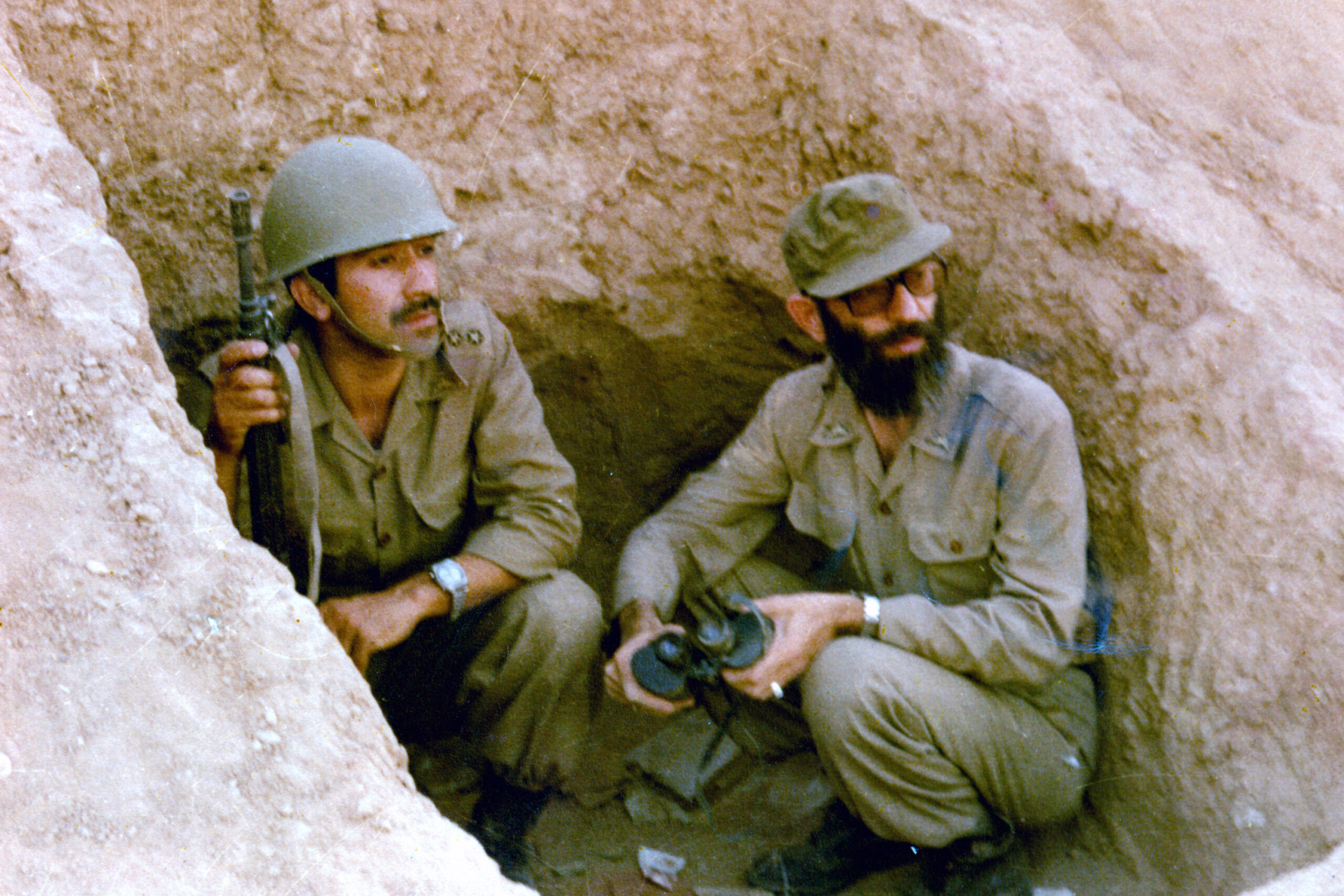
The Causes and consequences of the Iran Iraq war
Introduction
Britain’s withdrawal from the Middle East in the late 1960’s left unresolved territorial disputes between Iraq and Iran which led to the 1975 Algiers accord. But Iraq remained disgruntled and in 1979 the new Islamic Regime saw the majority Shi’a population of its immediate neighbour as a receptive audience for the export of its revolutionary ideals. Its subversive actions eventually goaded Iraq into invasion but a perception that Iraq’s invasion was an opportunistic attempt to resolve unsatisfactory territorial compromises is overly simplistic. In fact Iraq was initially tolerant of the new Islamic Republic’s overt interference and went to considerable lengths to offer friendship. But its initiatives fell on stony ground and, ultimately, the autocratic tendencies of two not altogether dissimilar revolutionary leaders came to dominate.
The war was unnecessarily protracted, painful and yielded little of substance. Whilst Iran derived a measure of satisfaction from its survival, and its citizens a new narrative of national identity, its ideas had been spurned by the wider Middle East and its economy devastated. Prime Minister Rafsanjani’s response seemed to draw on Marx’s mercantile capitalism, stimulated inflation, enriched Iran’s elites and deterred foreign investment, halting Iran’s economic development in its tracks.
Iraq was equally damaged, but in contrast heavily indebted. A burgeoning sense of injustice against the Gulf nations, which had benefitted from Iraq’s defence of their culture, erupted in the 1991 invasion of Kuwait. This turned the west firmly against Iraq, sowed the seeds of the second Gulf war and a collapse into a painful civil conflict which birthed the Islamic State and led to the Global War on Terror, at last supplying Iran with the hegemony it had originally sought.
Khomeini’s arrival
In 1979, when Ayatollah Ruhollah Khomeini arrived in Iran he was entering a country hungry for change.
But his radical agenda rejected not just the old internal order, and the Imperialist oppression which had formed the cornerstone of revolutionary rhetoric, but also the wider Middle Eastern order, which he regarded, arguably with some accuracy, as merely an extension of the Imperial oppression of Muslims.
Khomeini’s sought to replace this with an Islamic Umma which would transcend national boundaries drawn by Imperial officers and spread throughout the world. Since Iran was the only country where the “Government of God” had been established, the Islamic Republic would act as the springboard for the implementation of this strategy.1
In a speech on 11 February 1979, Khomeini made plain the extent of his agenda: “We will export our revolution throughout the world ... until the calls ‘there is no God but God and Muhammad is the messenger of God’ are echoed all over the world.”2
Iraq, two thirds of whose population were Shi’a, and whose history is coloured by Sunni persecution, was the largest and most powerful state in the Gulf and low hanging fruit for the Khomeini. A Shi’a uprising that emulated the Iranian Revolution was the intent.
Attempts to encourage an uprising began in mid-1979 with violent protests in front of the Iraqi embassy in Tehran while the new Iranian Ambassador to Baghdad publicly exhorted Iraq’s Shi’a to rise up and throw off the shackles of Ba’ath party rule.3 In principally Arab Khuzestan the Iraqi consulate was pillaged and its consul expelled. Schools teaching Arabic language courses were vandalised and teachers attacked.4 The regime renewed its support for the Iraqi Kurdish revolt and extended support to subversive groups.
Saddam’s ambition
In Iraq a not altogether different revolution surveyed its neighbour with caution. Saddam Hussein’s rise to prominence during the wave of revolutionary sentiment in the 1960’s had been characterised by violence and the revolutionary Ba’athist regime, having come to power by violence, was fundamentally insecure; it saw the world as “a violent and hostile place where the ultimate objective of staying alive, and in power, justified all means.”5
But Saddam was by then an ascendant force. The Arab league conference in Baghdad in 1978, and the 1979 Iraq petrol conference had confirmed Iraq’s primacy in the Arab world and a self-confident Saddam was enjoying the fruits of the 70’s oil boom. The regime had embarked on a range of ambitious economic projects and was preparing for the Non-aligned Movement summit scheduled to take place in Baghdad in 1982.
It was clear to Iraq’s leadership, perhaps reluctant to abandon an understanding of the Shah’s Iran which did not actively seek the regime’s elimination, preferring peaceful coexistence, that war with its powerful neighbour would waylay the country’s surging prosperity, curtail rising living standards and risk the regime’s survival. In the face of Iran’s powerful, western funded military, it was also by no means guaranteed of success.
So Saddam, despite a predisposition to violence, tolerated Iran’s provocations and sought to appease. Iranian Prime Minister Mehdi Bazargan was invited to visit Baghdad and Iraq offered its support should Iran decide to join the Non-aligned Movement.6 Saddam gave a televised speech reiterating Iraq’s support for the Iranian people, reinforcing the deep historical relations between the two countries and expressing a desire for friendship and cooperation.
The Iranian response was discouraging. Warplanes repeatedly overflew Iraqi airspace simulating bombing runs against Army barracks using the pretext that Mujahedeen opposing the Revolution were sheltering in Iraq and there were claims that Iraqi border posts had been shelled.
Bibliography
Baqer Moin. Khomeini : Life of the Ayatollah. New York, Thomas Dunne Books, 2000.
Ansari, Ali. Modern Iran since 1921 : The Pahlavis and After. London, Longman, 2005.
ʿAli MīrʹAnṣari. The Politics of Nationalism in Modern Iran. Cambridge University Press, 2012.
Yours sincerely,