
When US secretary for defence Pete Hegseth briefed the Pentagon’s case for the US’ current attacks against Iran he was clear. The US action, he said, had been unencumbered by the usual. There had been, he said:
"No stupid rules of engagement, no nation-building quagmire, no democracy-building exercise. No politically correct wars. We fight to win and we don't waste time or lives," 1
The Gulf states currently suffering the brunt of Iran’s reaction to the attacks must have blanched. As should we all. The second and third order effects of a new era of unchecked US imperialism will highly likely further unsettle the teetering international order.
The apparent absence of any form of checks on the President's decision-making will likely encourage Israel. And an unrestrained Israel, backed by massive US commercial and military fire power and without the counterbalance Iran has supplied for over four decades bodes ill for the Gulf. If not the world.
Certainly it is bad news for Lebanon, Syria, and Jordan, as well as for the remaining Palestinian occupants of the West Bank and Gaza. But more important is the risk that lack of restraint presents to other Arab states. If former guardians like much-weakened Britain and an inward looking America are not to be relied upon for security then who - or what - to turn to instead? These are arguments nations use to justify, in pursuit of national defence, the acquisition of nuclear weapons and fresh alliances. And the Gulf States have much to offer interested parties like China, India and perhaps even Russia.
So what is this about?
This is part of an imperialist campaign fought with an eye on the clock. With every explosion in the Middle East the clock ticks more loudly. Its alarm will shrill when both sides have exhausted their supplies of missiles. And long before a disorganised opposition is anywhere near "overturning" its evil theocratic leadership.
Iran’s clerical government defeated its opposition in 1979 because it rapidly institutionalised its control. Those institutions persist. They cannot easily be overturned. And the theocracy's Revolutionary Guard Corps, the instrument of its repression, remains unbowed. It has, after all, nowhere to go and – courtesy of a huge stake in Iran’s economy - vast sums to lose. It has already signalled – by nationwide text message – how stern its reaction will be to further protest.
Furthermore, Iranian shi'ism is founded in resistance. Attacks on Iran may well strengthen rather than weaken it. This is a nation whose reaction to Iraq’s invasion in the 1980’s was to send wave after wave of teenagers into battle in gleeful pursuit of martyrdom. Some of them armed only with plastic “keys to paradise” worn around their necks.
So, as the sponsors of the war know, expecting the fall of the Iranian regime is a gamble unlikely to pay off. More likely is a new version of the old regime prepared to moderate, at least in the short term, Khamenei’s aggressive foreign policy stance. At the economic, social and security expense of Iranians and Gulf Arabs.
With America unthreatened by near-nuclear Iran, Israel will be the major beneficiary of this war. It will replace Iran as the hegemon of the Middle East. Powering up its ability to act as America’s proxy in a key geopolitical region. Unrestrained by the rule of law, the strictures of the Geneva convention or humanitarian principles and utterly beholden to the US it will do a fine job of imposing its will. At no risk to its parent.
But where next will President Trump's avaricious gaze dwell? And what is to be done about it?
In his speech to the World Economic Forum earlier this year, Canadian PM Mark Carney called for middle powers to work together to counter the rise of hard power and the great power rivalry, to build a more cooperative, resilient world.2
Mr Carney was right. It is time for the middle powers to act in defence of the values and standards which used to be the guiding force of the democratic west.
The West fought a war against another wildly ambitious dictator in 1939. The expansionist oppression of Hitler's Third Reich featured the brutal persecution of minorities by a rhetorically and philosophically highly nationalistic state. It was characterised by invasion, occupation, regime change and land grabs across the globe.
It was defeated – painfully - by the forces of good. By men and women who represented the values and standards of the democratic west. The victory provided the foundation stone of the so-called “rules based international order” - the mechanism that has underwritten an era of relative global peace that has lasted, more or less, until today.
That structure may be dead in the water. Indeed it may never really have lived in the minds of anyone other than those seeking to use it as a source of justification for their self-interested political agendas. But that does not permission a powerful dictator to ride roughshod over standards and values our forebears fought and died for 80 years ago.
SOURCES:
Hegseth quote https://www.rte.ie/news/middle-east/2026/0302/1561220-us-iran-conflict/
Mark Carney WEF speech https://www.weforum.org/stories/2026/01/davos-2026-special-address-by-mark-carney-prime-minister-of-canada/
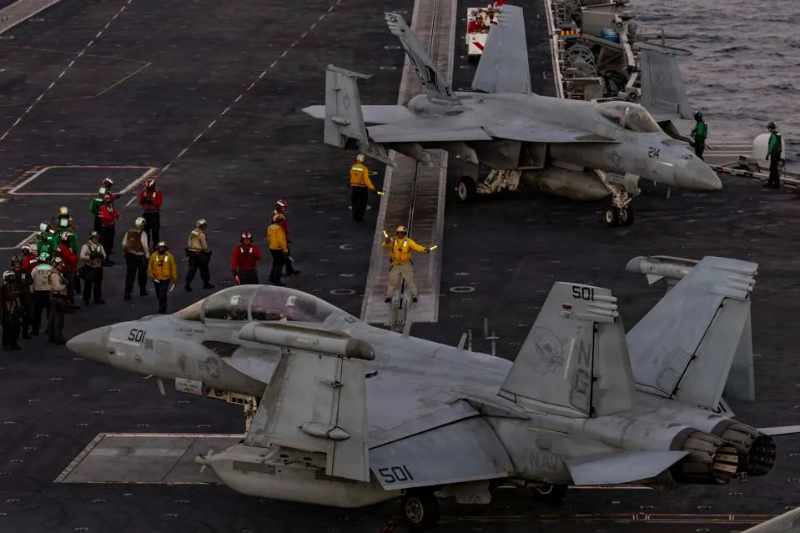
Image Courtesy of U.S. Navy / Mass Communication Specialist Seaman Zoe Simpson
The appearance of U.S. Department of Defense (DoD) visual information does not imply or constitute DoD endorsement.
Source: U.S. Navy
Credit: U.S. Navy photo by Mass Communication Specialist Seaman Zoe Simpson
Subject: Flight operations, USS Abraham Lincoln (CVN 72)
Rights: Public domain — U.S. Navy official imagery
Yours sincerely,