
Aristotle
The army has a habit of leaving soldiers in places where the stories make themselves. I started keeping notes. At the time it was for no particular reason. Now I am grateful, the notes jog my memory, fuel my writing.
One late morning in November I found myself in RAF Brize Norton’s uncomfortable Gateway hotel, in an assortment of casual clothes, with a ticket to a sandy country in the Middle East in my pocket and only a vast Bergen and some body armour for company.
The RAF Tristar to Cyprus was moderately comfortable, the food palatable and the stewardesses in their flight suits pleasant to watch. Cyprus was warm. As we filed off the aircraft there was no passport control, this was a transit site. Just over the ridge U2 spy planes were taking off with a deafening roar. A day later the cargo-netted discomfort of another C130. After an hour, for reasons known only to the pilot and presumably his commanders, the big aircraft banked hard and began to descend for an unscheduled stop. A group of muscular fellows joined us, all no eye contact and high-end climbing boots. In their midst a skinny little chap wearing a nervous frown, his suit badly creased. US diplomat and the practical workings of the so-called ‘special relationship’[, I thought, though I didn’t recognise the man himself.
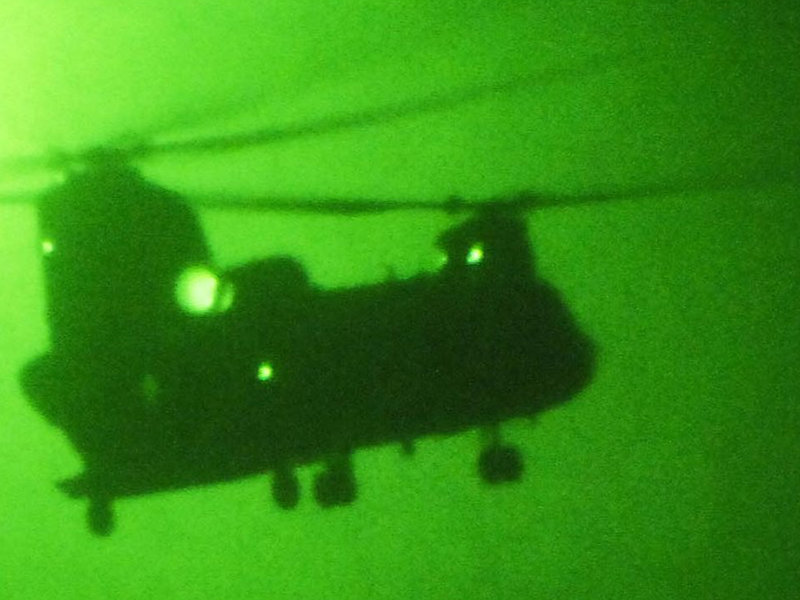
Eventually we found ourselves on board the inevitable Chinook listening to the automated popping of the aircraft’s missile defence flares as it rapidly gained altitude. The US flight sergeant in charge of his passengers was dressed for a role in Top Gun. Automatic pistol on the hip of his multi-pocketed flight suit, his mirrored visor preserving his anonymity, he was attached to his aircraft by a lengthy communications cable. And spent a lot of time balanced on the edge of the cargo ramp staring soulfully into the darkness.
We landed in the dust of a clear desert night, a full moon illuminating a yellow desert. As the dust settled and the heavy beat of the helicopter’s twin rotors faded, it was apparent that that was, really, it. An empty yellow desert and a pile of Bergens, their outlines lit by the dim glow of the cyalumes used by the RAF logisticians to mark their destinations.
And then, without warning, the moon disappeared. The pale-yellow desert vanished and darkness reigned. A faint rushing noise grew quickly into a deafening roar. Abruptly the air was full of biting sand, stinging cheeks and gritting teeth. Men covered their faces with their hands and ducked and scrambled for the shelter of the baggage.
The sandstorm was quickly over. The moon recovered itself and resumed its dignified gaze. The desert reasserted its jaundiced glow. But the pile of luggage had disappeared. And the sand remained in our clothing for days.
Half an hour later, tired of trying to find a comfortable place to sit and discomforted by the presence of sand in every wrinkle and crevice, we decided our lift wasn’t coming.
Based on the conviction of one of our number who had served here before, we began to walk, shouldering heavy bags and moving in a loose group. We headed for a near horizon, on which could just be made out the low outline of a building. Before long it crystallised into a crumbling concrete structure set amongst a collection of rock outcrops.
Our guide was no longer so sure of himself. We held a quick council. The area was known to be contested. Whilst the risk was formally regarded as low, the adversary was present, dangerous and keen to do us mischief. Nobody was armed. We were reliefs in post, picking up weapons from homeward bound incumbents at the end of their tours.
A decision was made. We had after all little choice. Cautiously we approached. The edifice seemed silent, uninhabited. After a moment, someone called out. The moon drifted behind a cloud. The silence was complete. Somehow everything felt wrong.
Then, from behind an outcrop barely twenty feet away a shapeless figure suddenly loomed, then another. Rifles at the shoulder. Slowly they approached. In the gloom it was impossible to make out the detail of their clothing or weapons. They seemed to be giants, shapeless for some inexplicable reason, covered in what looked like animal skins. We stood motionless, entirely unsure, increasingly convinced that the worst was happening.
Then suddenly one of the shapes spoke. The words were uttered in angry cockney.
“You the fuckin’ rotation from Cyprus?”
Relieved grunts of affirmation.
“Fuck, lads…” Genuine relief in the man’s tone.
“Fuck,” he said again, lowering his weapon and wiping a hand across his face.
“We’ve been fuckin’ searching high and low for you. Helo must have dropped you in the wrong fuckin’ place. Sandstorms in the desert play havoc with navigation.”
In the light of a head torch, the shapelessness was explained. The men wore goat cloaks purchased from local traders, warmer than uniform in the freezing nights and wonderfully photogenic for photos for home.
Handshakes all round, an outbreak of squaddie humour masking a relief felt by all.
The notes I made read nothing like the above. The redrawing was done with the help of the accurately styled “master of story” David Baboulene. But as he would willingly record, his magic comes from the ancient Greeks.
300 years or more before the birth of Christ, Aristotle laid out in his “progression” the essence of storytelling. Google David Baboulene, it is revelatory.
Yours sincerely,