
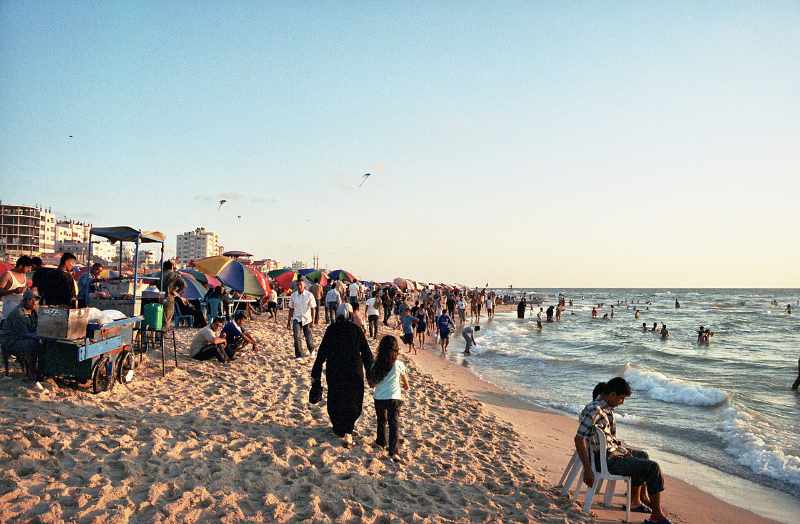
It is hot on the road by the beach. A tanker crawls slowly past the glistening white minarets of the Al Khaldi mosque. On its dusty white flanks, the Arabic word for water, in uneven letters, advertises its contents. Over the driver’s cab a blue and white UN flag flaps wearily.
Aging railings mark the road’s edge. Beyond it rhythmic surges of grey surf scratch sand dirtied by decades of discarded life. A blue and white embroidery of tiny flip flops and plastic bottles. Opposite, a long bank of rubbish, higher than a man, is dotted with small figures combing meticulously through its contents for anything of value. A child stands stares at the mound. His dark eyes are set wide apart in an expressionless face emptied of childish exuberance by the things he has witnessed.
A fretful horse bucks before a bombed-out house, another small boy determinedly gripping its oft-repaired canvas reins. The horse is blinkered, its scrawny flanks are dull with neglect. Behind it is a rickety wooden cart, still empty, waiting for the fragments of twisted metal and lumps of stone the boy will collect during the day.
Cursing, the boy hits out at the horse, striking its flanks with a thin wooden switch. It is a ritual. They are both used to it. The animal, having made its point, quickly settles.
He tethers the skittish animal to the bars of a window which has somehow survived the explosion that destroyed rooms it once lit. What is left is a giant, open-fronted doll’s house, its remaining floors a chaos of fallen masonry and builders’ steel. A child’s bed, still made, is visible in the corner of a room. Idly, he wonders whether the occupant survived the strike, pictures for a second that moment of terror as the shouted warning reaches the family; the mad scramble to leave, the crushing, deafening explosion. A once-home suddenly no more than a ruin of broken dreams.
The boy is tall for his age, well built. His skin is brown from the sun and his hair is cropped unevenly short. His face is serious, the dark eyebrows drawn together in an indelibly angry frown. He wears a simple t-shirt and shorts, a pair of ancient flip-flops. The shirt is emblazoned with English writing which he cannot read.
It is his physical size and strength which equip him, still on the cusp of adolescence, for the work he does. Combing through the wreckage and rubble of bombed-out buildings for steel bars, usable stonework, electrical material, pipes or wood. These are the things which have value. They are what the Israelis call “dual use” materials; anything which Hamas might be able to use to produce weapons. Such materials cannot easily be imported, especially now that most of the tunnels are closed.
It is heavy work, even dangerous. Sometimes he finds unexploded bombs, sometimes only after he has disturbed them. It is really a man’s job, but his older brothers are too busy these days.
He picks his way carefully across a pile of rubble, steadies himself on the broken door jamb. He surveys the rubble with a practised eye. Light streams into the wreckage from the broken floors above. A stray dog is startled by his approach, trots rapidly from the room with a low growl, leaping from stone to stone until it has regained the safety of the dusty yellow street outside. He bends and begins to move the debris, looking for something to salvage.
Inside the boy rages. Rages at the heat of the day, heat which saps his energy, makes his already challenging labours even more difficult. Rages at his mother for having brought six children into the world; six mouths to feed in such a place. Rages at the uncomfortable metal structure in which they are forced to live. Rages at the raw sewage stinking in the narrow alleys between the shelters, and at the water they cannot afford to buy and which lives in plastic buckets, often so brackish it is hard to swallow. Water so scarce they must all suffer the indignity of filth. On their persons, in their clothes. An odour they never seem able to escape.
Part of his rage is a guilty, creeping anger at his father’s absence. Killed by an Israeli strike at the wheel of the ambulance he was driving to pick up the victims of another bombing. The boy witnessed what little was left of the body, helped with the burial while his mother slumped in the dust wailing and ululating in the traditional way. Weeks ago now. Death here is not a tragedy, he thinks, it is a habit.
He straightens for a moment, holding up a slim metal sheet, turns it this way and that in the light. It is white on one side; an edge shows signs of having been torn by the explosion. It is perhaps part of a refrigerator. He throws it into a clear corner of the room to collect later. Squats again, sifting through the dust and rock, his hands dried and cracked by the continuous caking of dust.
There is nobody now to provide for the family, and it falls to him to wheel his sister to the Al Shifa1 hospital. To comfort her against the pain she must regularly undergo as UN nurses dress her burns and the open shrapnel wound which will not heal. It means he misses the afternoon shift he attends at the UN school. A school which offers just the tiniest sliver of hope that, one day, things for him might improve.
The boy has little doubt that her injuries will probably soon kill her. Nowhere in the Strip can they properly treat wounds of this nature, this severity. They long ago applied for a permit to take her for surgery in Egypt. It has been a year already and nothing has happened. He hopes permission will come; he would like to see something of the world outside the Strip. Sometimes, when his work takes him nearby, he eyes the crossings with envy. The crossings at Erez and Beit Hanoun in the north and at Rafah in the south are for him the only ways out of Gaza. Vast concrete and metal structures, defended by guards and concrete vehicle traps. Often closed. The queues can stretch for hundreds of metres.
His two older brothers have become elusive of late, hardly seen by their family. Both are members of the Izz al Din al Qassam brigades2, Hamas’ commando forces. He knows it earns them far more than he can ever hope to earn, perhaps as much as ten times what others earn. They have grown fit and strong. On recent visits they have been taciturn, as if in possession of a great secret. They murmur quietly to each other and if he strays within earshot they will stop talking, flapping a dismissive hand at him to move away.
He knows they are training on the mock-up of an Israeli Kibbutz, built for the purpose of practising attacks on Israel. He has seen the structure from his little cart, seen the young men in combat fatigues with assault rifles. They are practising for attacks that nobody expects will happen. Yet more wasteful schemes by the Hamas government. Money which would be better spent on improving the electricity supply, solving the problem of sewage or simply making water available for thirsty Gazans.
But it cheers him. They are not so much older than he is. Soon he too will join the brigades. He nods, allows himself a half smile. They will give him a rifle to use to kill Israelis. It will be more satisfying than throwing rocks.
Combing through the rubble, shifting rocks from one place to another, searching for what might be concealed beneath them, he curses Hamas as well. Hamas is a government in name only. He thinks they are cowards. Hamas encourages the youth to protest at the border fence, but none of its leaders join in such actions. He himself has joined the so-called “Great March of Return” several times.
He snorts. The “Great March” is actually a dangerous, depressing walk along the border through the ruined sandy soil of what once were prosperous farms. Farms until Israeli diggers destroyed them, again and again and again until the farmers were forced to abandon the poor soil and their simple homes. Now there is nothing but the decaying corpses of the camels and sheep killed by the air raids and artillery fire, and the torn white canvas flapping in the wind against the tired frames of the greenhouses previously home to rows of cucumber plants and ripening tomatoes.
Now the Israelis have their buffer zone; their machine guns and tank turrets can sweep the open land unimpeded by the farms.
He strains against the burden of a larger rock, feels it slide, uses all his strength to encourage its movement. Eventually, it shifts and rumbles a distance, exposing the debris below. He straightens to rest a moment, palms sweat from his brow, the dust on his hands rough against his skin.
He thinks of the futility of the shouting and stone throwing at the fence. Overhead, the infuriating ever-present buzz of the drones, boys using home-made slings to extend the range of their stones against the Israeli soldiers in their vehicles and watch towers. Flaming balloons sent over the fence in the hope of causing fires in the farms and buildings of the neighbouring Israeli Kibbutzes.
It is usually then that the shooting starts. The soldiers shoot deliberately low. Many of his friends have been hit in their legs, some have even lost limbs.
His attention returns to the rubble. Cautiously he enters what must have been a back room, spies in a corner a curved tube, just visible in a pile of dusty stones. Part of a table lies atop the mound, obscuring its contents. A child’s plastic shoe balances on one corner. He slides the tabletop to one side. Inwardly he wonders if today he will strike it lucky, happen across something of real value. Something valuable enough to sell for much more than the five shekels he will make for an average load. He pulls carefully at the tube. It is stuck fast. With his hands, he begins to move the stones surrounding it.
An hour later he emerges from the ruins, covered in dust. With enormous reverence he carries something. His small frame can only just master its heavy weight. His steps are small and awkward, he must avoid falling in the rubble. He is exhausted by the time he has manoeuvred into his cart. Exhausted but happy. It is the battered remains of a small and badly damaged generator. The kind that the luckier families rely upon amid the 18-20 hours of daily power outages. Generators which power phone chargers and electric lights and showers for washing. Heating in winter. It is a stroke of enormous good fortune. Selling the generator, however crushed and broken, might feed his family for as much as a month.
Later he settles in a corner of their shelter to try to study. The guttering flame of the candle is barely enough to see by. He must be careful lest the flame start a fire. He looks around, stares for a moment at his four-year-old twin sisters sleeping wrapped in each other’s arms, and wonders what hope there is for any of them.
He sighs. Hunkers down over his studies, squints at the dim writing. Tomorrow, he thinks, tomorrow he will see if any of the fishermen need a young helper. He has heard talk that the occupiers plan to expand the stretch of water in which they may fish, from six miles currently to perhaps nine. If they do, there will be a mad rush for the new fishing grounds. They will need all the help they can get.
The Gaza Strip borders the Mediterranean coast in southern Israel for approximately 25 miles, stretching inland for up to seven miles. It is the only patch of land to which Egypt was able to cling after the abortive war of 1948. In that year, thousands of refugees driven from their property by Zionist gangs bent on paving the way for the formation of the state of Israel made their new homes in its eight sprawling refugee camps. Camps which exist to this day.
The Israelis retook the Strip in 1967 and it remained under military occupation until 2005, when it came under the continuous governance of the group known as Hamas.
Since 1994, the Strip has been completely encircled by a barrier, consisting of a combination of fences and a 7 metre high wall where the border runs close to Israeli settlements. The barrier is equipped with sensors, remote-controlled machine guns and barbed wire with watch towers every mile or so. The barrier is subject to ground and air patrols. More recently, Israel has constructed an underground ‘anti-tunnel’ barrier dozens of metres in depth, equipped with sensors to detect tunnel constructioni.
Life in the Gaza Strip for its some 2.2 million inhabitantsii is extremely hard. Since 2007, the Strip has been subject to a strict blockade. More than 930,000 were in receipt of UNRWA assistance before 7 October 2023, amounting to some 500 lorry-loads of aid supplies daily. Unemployment in the zone is more than 41% and overall youth unemployment exceeds 60%. Power cuts average 18-20 hours a day. Real wages have exhibited continual decline (30% in total over the past 20 years) and exports have collapsed almost entirely.
The fishing industry on which thousands of Gazan families rely has been steadily hollowed out. Fishing is restricted to a distance from the shore of between three and six nautical miles since 2007, forcing a depletion of inshore fish stocks and a dramatic decrease in fish catch. The Israeli Navy regularly fires at or impounds fishing boats. Restrictions on the import of “dual use” materials (materials which Israel deems could be used by Hamas in the manufacture of weapons) renders boat repair expensive and very difficult.
Agriculture was an integral part of the Gazan economy, with Gazan farmers growing an array of crops such as plums, olives, grapes and dates. In 1967, over 80% of Gazans’ crops and 45% of their production of fruits were exported. Now the construction of barriers and the buffer zone implemented by the Israeli armed forces has seen the loss of around 29% of Gazan agricultural land, leaving some 60% of Gazans “food insecure”, and dependent on Israel for over 82% of their importsiii.
The lack of running water is perhaps the biggest problem for Gaza’s inhabitants. The Strip benefits from no perennial streams and rainfall is low. The mains water network has been repeatedly damaged by Israeli bombing. Gaza is therefore dependent on its aquifer. However, the aquifer’s water is salty and undrinkable, and increasingly polluted by both uncontrolled sewage and agricultural fertilisers. As a result, 96% of Gaza’s water is unsafe for drinking. Most rely on private desalination plants for their drinking water, or are forced to buy expensive potable and non-potable water from tankersiv. Following the 7 October 2023 attacks, with a significant worsening in basic facilities, over 130,000 cubic metres of wastewater are being released into the Mediterranean dailyv.
Before the 7 October attacks, Gaza’s 35 hospitals, with a total of 3,512 beds, were already operating at full capacity.vi Medical care was limited by lack of specialised treatment facilities and training opportunities for staff, as well as frequent power interruptions. Access to medical care abroad is restricted by Israeli controls on Gazans leaving the Strip, and protracted delays in permit issuance.
So What?
Since Hamas’ democratically elected government took power in 2007, Gazans’ lives have worsened continuously at every level. Now, Israel’s “Swords of Iron” military operation has left an estimated 30% to 70% of Gaza’s residential property damaged or destroyedvii. These estimates take little account of the infrastructure – for water and electricity supply, medical care and education – previously already wildly insufficient, now destroyed or beyond immediate repair.
Estimates for reconstruction cost run as high as $50 billion but are unlikely to fully reflect the scale of necessary expenditure. In any case, they fall short of identifying a willing donor.
Even the most cursory examiner of the history and nature of Gaza will notice a consistent theme: a decades-long attempt to render the lives of Gazans unliveable. Hamas’ attacks on 7 October 2023 granted Israel an opportunity to complete this work, while the international community looked on, leaving much of Gaza likely uninhabitable for a generation or more.
Practically, Gaza’s future is now clear.
Those brave Palestinians determined to avoid being forced from what is left of their land and property will gravitate inexorably – driven by starvation, thirst and rampaging disease – into tented camps operated by the UN.
Israel’s ongoing “special military operations” to remove the remnants of Hamas’ fighting power will see to it that reconstruction cannot commence, much less be completed.
In the end, neighbouring countries will relent and exhausted Palestinians will be offered new homes in places in which some semblance of the dignity of which Israel has robbed them in 75 years of persecution may be regained.
For Gazans, the process David Ben Gurion, Moshe Dayan, Yitzhak Rabin and others designed to drive Palestinians from the so-called biblical “Promised Land” is nearing completion.3
Yours sincerely,