
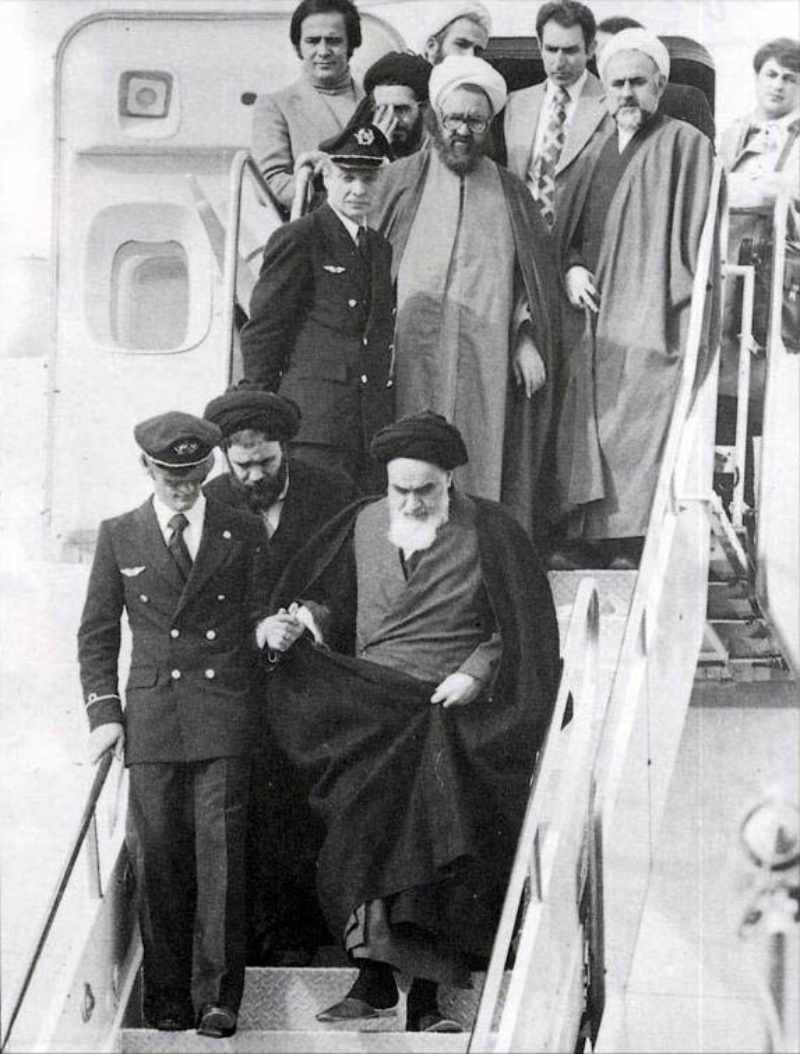
This is the third of four posts on how Hizballah actually came to exist. Last week I explained how Ayatollah Muhammad Hussein Fadlallah built on Imam Musa al Sadr’s work in creating of the Lebanese a political force and created the religious basis that converted traditional Shi’a “quietism” into armed resistance.
This week: how Israeli military heavy handedness forced an essentially Lebanese resistance group into the bosom of Iran’s brand new Islamic revolution.
The 1979 Islamic Revolution in Iran.
1979’s Islamic Revolution presented another dilemma. Lebanon was one of the very few Arab democracies. Its press was free, political groups could organise, and it offered unparalleled openness to the outside world. Lebanese clerics worried that to follow Khomeini and demand an Islamic state in Lebanon would sound a rejection of the confessional system and risk losing the all-important recognition of the state.
It fell to Fadlallah to translate the revolutionary message for a Lebanese audience.
He regarded an Islamic state in Lebanon’s multi confessional system as impractical, calculating that “the possibility in Lebanon of a national religious upheaval similar to that of 1978-79 in Iran was very remote, owing to the country's heterogeneous population and regional opposition”.
He knew that many clerics resisted the idea – Ayatollah Shams al Din, head of SISC, was lukewarm whilst his deputy, Shaykh Abdul Amir Qabalan entirely rejected the idea. Ayatollah Kho’i, whom Fadlallah officially represented, openly disagreed with Khomeini. believing that clerics had no business in politics.
Fadlallah therefore advanced the view that velayat e faqih was not exclusive and that a “multiplicity” of leaderships was, for practical purposes, legitimate.
To avoid incurring the wrath of Tehran he proposed a gradualist strategy borrowed from the Egyptian Muslim Brotherhood, involving a peaceful infiltration of selected institutions as a means of spreading the revolutionary message. Only when the majority of Lebanon's citizens were in favour, and when political circumstances in the region were conducive, could an Islamic government be installed.
1982. Israel Invades.
On 6 June 1982, when Israel’s invasion began, jubilant Lebanese Shi’a met the invasion force with handfuls of thrown rice. They saw the Israelis as liberators, driving the detested Palestinian gunmen from their land. Amal remained formally neutral and its leadership instructed its fighters not to resist. Not all were quite so welcoming. In southern Beirut Palestinian, Syrian, Lebanese and Amal militants, including Khomeini-inspired radicals put up a stiff resistance. Their unity was founded on the shared experience of Israel’s indiscriminate bombing and blockade of the Palestinian camps in the “belt of wretchedness” of Southern Beirut which the Palestinians shared with the displaced southern shi’a.
At the time Fadlallah was in Tehran attending a conference for Islamic liberation movements from around the world.
He was quick to realise that the Lebanese grievance against Israel could be used to build support for his agenda, and to attract the favour of Iran.
The delegates requested assistance, immediately supported by the governments of Lebanon and Syria.
Tehran regarded the invasion as a golden opportunity to “spread Islamic revolution to the front lines of the arab Israeli conflict” and President Khameini initially saw no difference between the Iraqi front and the new Lebanese front.
A delegation was sent to Syria to gain the approval of President Assad. But Assad feared Iran might weaken its ally Amal, and its hold on Lebanon and reignite the civil war. But, having only months previously signed a lucrative trade agreement with Iran he was in no position to resist the request.
Units of Pasdaran were ordered to the Syrian border with orders to “engage in face-to-face battle with Israel, the primary enemy of Iran and the Muslims.”
But by the time the some 5,000 IRGC troops arrived the fighting was over.
Iran’s leaders were in any case facing the major distraction of war with Iraq and it was long before the terror of a repeat of the horrors of war with Iraq would lead to a desire for its own proxy force. Tehran’s interest quickly waned and in a damning indication of where Tehran’s priorities lay it was agreed that Israel’s victory was complete, and that the retreating Palestinians were beyond help. The soldiers were ordered home leaving only a small force in the Bekaa.
Israel’s provocations.
Fadlallah was now the most influential cleric in Lebanon and chief influencer of the opposition to the invaders.
Israel did much to inflame Lebanese resistance.
Major Saad Haddad’s “South Lebanon Army” was permitted to implement a harsh tax regime in the southern buffer zone on everything from car registration and building sand to gas sales. The Israelis consolidated their control with check points and barricades, appropriated farming land for bases and helicopter landing pads and established a mercenary force of armed Shi’a guards for the southern villages and rounded up those who preferred not to collaborate, interrogating them in prison camps in what was nicknamed the “north bank of the Jordan”.
On 20 July 1982 Amal’s leader Nabih Berri decided that Israel’s overwhelming firepower rendered resistance futile and joined the US-Lebanese National salvation Committee.
The decision caused outrage. Hussein al Musawi’s Islamists regarded this as a collaboration with the Imperialist US and their Christian allies. Leading figures resigned. Iran saw it as an “American committee”. Amal was in any case poorly integrated, with an array of members from different districts and differing persuasions and the resignations quickly became a flood. Musawi left with 500 followers and announced a new breakaway group called “Islamic Amal”.38
Israel’s occupation of the south meant the rebels’ options were limited.
The remote Bekaa, where Iran’s Pasdaran had entrenched themselves, was the obvious choice.
The Pasdaran soldiers had made themselves useful. They were busy transmitting the revolutionary message and had inspired a sort of revolution of their own. Women had taken to wearing the abaya, bars had ceased to serve alcohol. A radio station called “Voice of the Iranian revolution” was broadcasting sermons, religious programmes and news. They had built tunnels into the hillsides in which to instruct in guerilla warfare techniques and Iranian revolutionary Shi’ism and arranged for anti-aircraft weaponry to defend them.
Yours sincerely,