
This is the fourth of four posts on how Hizballah actually came to exist. Last week I explained how Israel’s military heavy handedness forced what was initially “just” a Lebanese resistance group into the bosom of Iran’s energetic new islamic revolution. This week: how Fadlallah melded disparate elements into one group - the founding moment of today’s Lebanese Hizballah.
The beginnings of a unified group.
The new arrivals in the Bekaa formed a loose coalition.
They were defectors from Amal, members of the Lebanese union of Islamic students, former members of Lebanese Dawa, and a variety of other groups of radical Shi’a militants as well as those searching for new paymasters after the departure of the PLO. Khomeini’s continuing support for the Palestinian cause helped blur the distinction between Sunni and Shi’a and overcome the former’s fundamental rejection of velayat e-faqih. This allowed connections with Arafat’s Fatah and other Arab Lebanese to be included. The coalition quickly became a serious rival to Amal.
The group was led by Lebanese clerics, all of whom had studied under Baqr al Sadr in Najaf and were close to Fadlallah. What they lacked in terms of a structured framework they made up for with ideas. But unlike Amal, whose unity depended on the charismatic Sadr, the new coalition was united by a common agenda and philosophy. One provided by Fadlallah - of resistance to the Israeli invasion and occupation.
In the following weeks the key clerics - three from the Bekaa, three from Islamic Amal and three to represent the remaining factions - issued a “manifesto of the nine”. This recognised the leadership of Velayat e Faqih and claimed Islam as its guiding light. It identified resistance against Israel as its ultimate priority. A delegation met Khomeini who stated that “only deeds mattered” and Iran’s High Defence council approved plans for a new “Council for Lebanon” composed of five members, to be supervised by Khomeini’s personal representative. On its return to Lebanon the new leadership council began to create the necessary organisational structures and ideological identity based on Sharia law.
Where Fadlallah leads, Tehran follows and Israel Missteps.
It was Fadlallah who stood behind the new formation’s philosophy.
In June 1982, Tehran had encouraged the delegates to the Islamic Liberation conference to form an ecumenical association of activist ulema. It was called ‘Tajammu al Ulema al Muslimmeen’ and its mission was to “inculcate the necessity of Sunni-Shi’a concord and solidarity and to function as a vanguard for mobilising mass resistance to the Israelis.”
Fadlallah, because of his “long standing ecumenical views” was given the lead role. The Tajammu served as a convenient front organisation for Hizbullah, and the platform for Fadlallah’s guidance, without imposing on him organisational responsibility or the role of spiritual leader.
Whilst Iran confined itself to providing religious instruction and military training in the Bekaa, Fadlallah’s influence grew fast. His mosque in the B’ir al Abd area of Beirut became a hotbed of anti-Israeli rhetoric designed to attract young Muslims. He publicly lambasted Arab regimes for their nationalist orientation and acceptance of western patronage. He was, says Sankari, “the most influential and articulate Islamist cleric in Lebanese Shi’a Islamist circles” and was regarded as a Juridical authority and ideological guide.
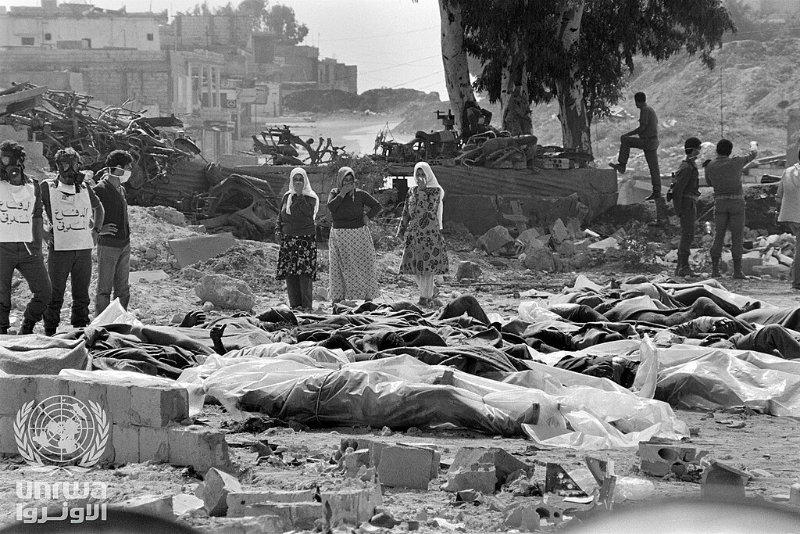
He was ably assisted by the various missteps of the Israelis. In September 1982 the massacre of unarmed refugees in the Sabra and Shatila camps caused outrage both in Israel and abroad and led to Israel’s withdrawal from West Beirut.
In early 1984 Shaykh Raghib Harb, the young firebrand cleric and virulent opponent of ISR occupation of south who had accompanied Fadlallah to Tehran in June 1982, was assassinated, reportedly by gunmen hired by Israel46 and, together with the US sponsored agreement for withdrawal of both Israeli and Syrian forces on 17 May 1983, provoked nationwide protests.
Most significant was an incident in the town of Nabatiyeh during Ashoura, October 1983. An Israeli patrol drove into a Shi'a procession. The soldiers began firing to clear a path through the 50,000-strong crowd. Several mourners were killed. Dozens were wounded. Israeli vehicles were set ablaze by the angry crowd. It was enough for Amal’s clerics, and especially Shaykh Shams al Din, then chairman of SISC, to finally come off the fence.
By 1985 and Israel’s implementation of collective punishment the occupation was becoming untenable.
In February Hizballah issued its first communication - “an open letter to the downtrodden”. It was a manifesto declaring an intent to drive Israel from Lebanon and obliterate it from existence, and to end French and US influence making way for Lebanon to select its own government. But it expressed only a preference for Islamic rule, stating carefully that it had no wish to enforce it.
Conclusion.
Hizballah cannot easily be seen as Iran’s creation.
Iran, at the time, was both distracted by war with Iraq and incapable of translating its Islamic revolutionary message in terms acceptable to the Lebanese Shi’a. It was also years away from understanding the usefulness of proxy forces.
Instead its genesis was the coincidence of the interests of the Lebanese Shi’a with the exigencies of Iranian foreign policy in the context of Israeli invasion and occupation of the Shi’a homeland.
Whilst Hizballah did operate under the “guidance of (Khomeini’s) ideology, outlook and agenda”, according to Hassan Nasrallah the group actually arose “purely as a local spontaneous initiative spawned by extraordinary local conditions in the wake of Israel’s invasion.”
Particularly, Hizballah could not have emerged without Ayatollah Fadlallah. He was “Hizballah’s oracle—a fount of infallible (if ambiguous) guidance, fed by an unfathomably deep well of wisdom. He rallied the masses to the movement and then kept them from following paths to self-destruction. The movement and the man guaranteed one another’s survival.” It was Fadlallah, therefore, who adroitly adjusted for the Lebanese context and united its disparate interests to suit his own, much wider agenda. His philosophy had broad appeal in occupied Lebanon - “Israel was illegitimate and had no right to exist as a nation-state because what God had ordained could not be contradicted: that theft and usurpation are illicit.” He maintained that only a united Islam could restore independence and expel the usurpers.
His social and political agenda, based on gradualism, was highly pragmatic and according to Sankari, “responsible for formulating the guiding principles of the party’s long and short term goals” and his attitude to Syria’s Arab nationalism allowed President Assad to provide important support when the various agreements with Israel threatened disarmament and disestablishment of it and other militant groups.
But Fadlallah also went on to supply the religious legitimacy for the traditionally peaceful Shi’a to take on their foes with force, enshrining in the resistance philosophy the process of retaliation: “Israel kills our children and elderly and shells our villages while it sits in safety. It must be made clear to Israel that when one of our civilians is killed by its rockets, a Jewish civilian will also be killed by one of our rockets.” And by providing justification for the use of the suicide bomb he made available the weaponry with which Islam could contest the overwhelming military prowess of the west could be contested.
In effect, whilst Fadlallah preferred not to limit his authority by becoming leader of Hizballah, it was his guidance which allowed other leaders to build and unify a sizable group of followers into today’s Hizballah.
Yours sincerely,