
This is the first of four posts on how Iran's foreign policy actually developed over the last hundred years, and how the attacks of 9/11 and the Global War on Terror transformed it completely.
Iranian foreign policy in the 20th century and how it was influenced by 911 and the launch of the global war on terror.
Introduction
Iran’s perception of itself as a grand imperial power is matched by a parallel perception of its history as one of “futile wars, unequal peace treaties, unfinished or ineffectual reforms and movements” (Tabatabai, Ariane. No Conquest, No Defeat : Iran’s National Security Strategy) and a sense of victimhood at the hands of the international order and its persistent and damaging interventions in the country’s affairs. This has driven a powerful desire to avoid a repeat of past misfortunes, and an evident determination to restore Iran’s Great Power status as the natural regional hegemon.
The extraordinary demands Iran made of the Great Powers at the 1919 Paris Peace Conference should therefore come as no surprise. Neither should Mohammad Reza Shah’s US sponsored pursuit of regional superiority or the Islamic Revolution’s radical ideological plans for an Iranian led Islamic Umma spanning the Middle East. All demonstrate the nation’s deep-seated sense of its own exceptionalism.
However, whilst this sense of its own international importance is inevitably a key driver, it is clear that domestic events, internal political agendas and the adventurist military errors of others have played an equally important role in the foreign policies of successive administrations for the last 100 years or more.
Thus was Ayatollah Khomeini’s revolution, motivated by a deep-seated Iranian desire for freedom from its domestic autocratic history, to turn a previously Iranophile west into Iran’s enemy, push the Arab states closer to Israel and leave Iran isolated and weakened by war with its neighbour. Then came the results of Iraq’s ill-considered invasion of Kuwait - the 911 attacks, the launch of the Global War on Terror, Gulf War II and the birth of the Islamic State. These cemented western hostility to the Islamic world and forced a new type of security thinking on Iran’s leadership, suddenly painfully conscious of the vast weight of western military and political power arrayed against it.
With the promotion of General Ghassem Soleimani to chief of Iran’s Quds Force these events introduced a new, aggressive, expeditionary strategy amid renewed distrust for the international system, an implacable hostility to the west and Israel, and a recognition of western military superiority. Its focus was on cultivating instability in neighbouring geographies using non state clients to raise the cost of western engagement at minimal expense to Iran and create opportunities for the projection of Iranian influence. It was to grant the Islamic Republic unparalleled influence across the Levant and an ability to threaten Israel, the Gulf states and the west without exposing itself to unacceptable risk within its own borders. Greatly assisted by weak western strategic thinking which permitted Iran’s proxies to gain control of Iraq and Syria, facilitating a considerable expansion of the capabilities of Iran’s key international client, Lebanese Hizballah.
Meanwhile Iran’s nuclear programme, ostensibly for civil purposes, was cunningly weaponised so that it appeared to supply the regime with the suggestion of an unacceptable, if nascent, military capability without ever actually doing so, at last providing Iran with the necessary lever with which to gain its long sought after global influence. In short, “through no effort of its own the Islamic Republic has been able to conceive an imperial mantle and role which the monarchy it overthrew could only have envied”. (Ansari, Ali. “Avoiding the Worst Case Scenario: Iran and the Real Possibilities of Engagement)
The end of the Qajar Monarchy
At the turn of the twentieth century it was clear to Iranians that the driving characteristic of its foreign strategy had been an unhealthy subservience to Russia and Great Britain. With Britain fresh from victory in the first war, Russia weakened by revolution, and Europe alight with ideas of a modern international system, based on the rule of law and driven by new ideas of self-determination,3 an opportunity for Iran to adopt a direction more suited to its own sense of imperialism seemed to present itself.
In March 1919, therefore, the Qajar monarchy of Iran, despite its tenuous grasp on power, despatched a delegation to the Paris Peace Conference. Its intent was to petition the three Great Powers – Great Britain, France and the United States of America – for the return of Iran’s lost territories. The delegation was to emphasise the vast sweep of Iran’s traditional lands – including Iraqi Kurdistan, parts of Turkey as well as large parts of modern Turkmenistan, Uzebekistan and Kazakhstan south of the Amu Darya river. The demands illustrated deep seated feelings of Iranian exceptionalism and of its importance on the regional stage and was a clear expression of Iranian independence. Its preamble manifested a sense of antiquity and historical imperial credentials and contained not the slightest suggestion of the uncertainty and insecurity which characterised western perceptions of Iran.4 It was the continuation of a historical thread which was to mark Iranian Foreign policy throughout the ensuing period and which would continue to the present day.
The treatment of Iran’s submission - the fully functioning government required to administer such a vast and unruly territory was simply not something Iran could boast - hammered home the challenge Iran faced if she was to resume what she regarded as her rightful place on the world stage. The task of developing the necessary instruments and agencies of a functioning nation state therefore fell to Reza Shah Pahlavi on his accession to the Iranian throne in 1925.
The advent of the House of Pahlavi.
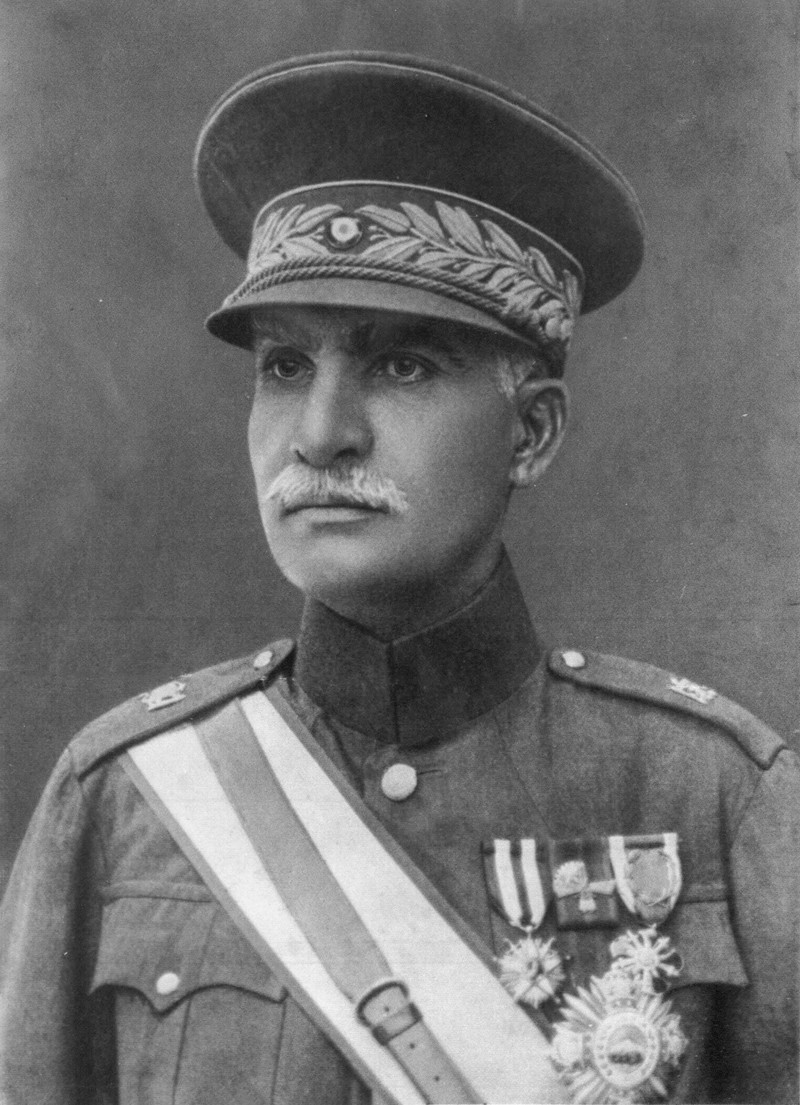
Reza Shah Pahlavi’s rise to power reflected Iran’s failure to achieve self-determination. Attempts at reform had fallen on stony ground and the bones of the Anglo Persian agreement of 1919 merely demonstrated the nation’s impotence. The intelligentsia felt that the European experience could only be attained with the help of an enlightened despot capable of “dragging Iran kicking and screaming into the modern world”.5 Reza Shah was an excellent fit. At six foot three inches tall with the “grizzled” appearance of a Cossack trooper he was an imposingly authoritarian figure with a noble military lineage.6 In practice he did not disappoint. Having first secured his position in government, he set about unifying the unruly tribes and restructuring, enlarging and strengthening the “soul of the nation” – the Iranian army. He also did much for Iran’s infrastructure, building roads, schools and hospitals and the first university.
But whilst Reza Shah’s desire to implement internal reform was matched by his determination to restore Iran’s national pride, it was clear that without the necessary tools of administration, the broader goal of overturning foreign influence was unattainable. Thus, whilst initiatives like the abolition of capitulatory rights, the removal of Arthus Millspaugh from his controlling position in the Treasury and the establishment of Bank Melli as National Bank of Iran were important steps in the direction of Iran’s emancipation from imperialist influence, they stopped short of real independence. Indeed, even the unilateral cancellation of the D’Arcy oil concession in 1931 - initially seen as a powerful statement of independence - was rapidly followed by a renewal of the agreement on terms only marginally more beneficial than previously. And when the Shah’s major foreign policy initiative - the development of a partnership with ascendant Germany to counterbalance British and Russian influence – started to threaten Iran’s critical war time oil resource, it was enough to precipitate invasion, his abdication and exile in favour of his son Mohammad Reza Shah and, finally, a pathway to international significance for Iran.
Bibliography
Claims of Persia before the Conference of the Prelominaries of Peace at Paris. UK FCDO, Mar. 1919, file:///C:/Users/davie/OneDrive/Personal%20skydrive/St%20Andrews%20Masters%20degree/Iran%20and%20the%20world%20since%201921/Constitutional%20revolution/ClaimsofPersia.pdf. Accessed Apr. 19AD.
Grobien, Philip Henning. "Iran and Imperial Nationalism in 1919." Middle Eastern Studies, vol. 57, no. 2, 12 Dec. 2020, pp. 292–309, https://doi.org/10.1080/00263206.2020.1853535. Accessed 31 May 2021.
Sackville-West, Vita. Passenger to Teheran. 20 Dec. 2022.
Ansari, Ali M. Modern Iran. London, Routledge, 2016.
Yours sincerely,