
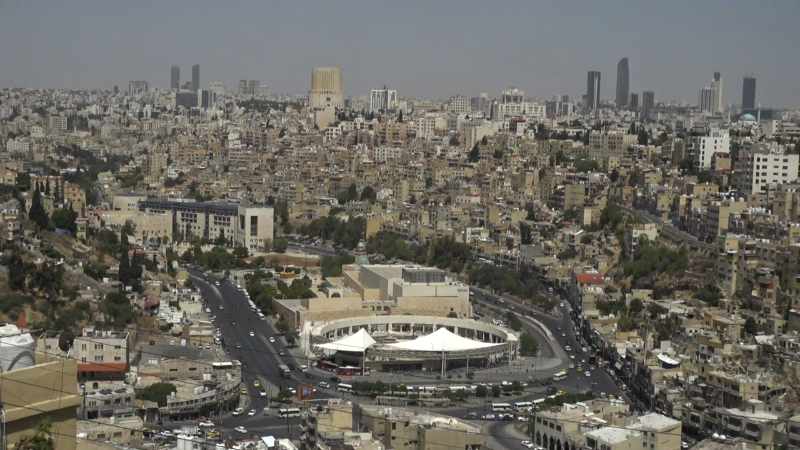
Amman, Jordan
The skies over Jordan’s capital city are a shimmering blue, the temperature hovering at a comfortable 24 degrees Celsius. Khaled Meshal gazes thoughtfully from the window of his Mercedes at the traffic teeming between the tightly packed residences and the parked cars which line Amman’s Gardens street.
The black eyes are unfocused, his face expressionless beneath the thick dark hair and beard. Images run in his mind. Amidst the shattered seats and tables of a restaurant, canopies brought to the ground by the explosion bury bodies in debris, their clothing in tatters, exposed limbs covered in blood. Nearby stand ambulances with their doors hanging open, their emergency lights on their rooves flashing silently. Dozens of figures manoeuvre between and around them. Some are uniformed, others are passers-by in civilian garb. Many wear the kippahs1 of their Jewish faith. They carry stretchers bearing the dead and wounded. Their movements are hurried, panic etched into their faces.
Meshal knows the numbers. This time there are five dead and nearly 200 injured. In three attacks this year Hamas has killed more than 20 Jews on the streets of Jerusalem and Tel Aviv. More than four hundred have been injured.
It is his responsibility. In the Sheikh’s absence, he is the group’s leader. He chairs the political committee which sanctions these killings, hands operational responsibility for them to the group's military wing. His rational mind is not unduly disturbed, it is the horror that refuses to leave him; wakes him shouting in the middle of the night.
He glances at his children in the rear seat. The bodyguard will take them to the hairdresser’s after dropping him at his office. He wonders whether they will survive the debt he is building for his family. His brow clouds, he is aware, as they all are, of the Israelis' determination to root out and kill Hamas’ leaders. Mossad has a daunting record. First the Nazis, then Black September after the massacre at the Munich games. Since then hundreds of others. There seems no limit to their reach. He hopes that the peace agreement Israel has signed with Jordan three years ago, the ink barely dry on an undertaking not to conduct covert activity without Jordanian approval, is sufficient to safeguard his family in Amman.
In the car’s back seat, the children squabble over a plastic figure of a Palestinian fighter. It is dressed in US style fatigues and clutches in its rigid fist an assault rifle. The younger boys argue that each has first rights to it; their older brother, ever the peace maker, tries to calm his brothers.
Beside him at the wheel, Meshal’s bodyguard casts suspicious glances in the rear view mirror. A dark green car follows them, two figures in sunglasses dimly visible in the front seats. After a time, the car finds a gap in the traffic, accelerates, charges past. Its occupants ignore the Mercedes. The driver relaxes, concentrates on navigating the big car through Amman's congested streets, ignoring the growing hubbub in the back seat.
At the same time, a little over two kilometres to the east, hidden from view behind bulletproof and darkened windows in the inscrutable concrete facade of the Israeli embassy on Maysaloun Street, an operations room has been commandeered.
In hushed tones in the coffee areas and over lunch in the canteen, the Embassy's resident staff discuss the curiously low-profile arrival of the six newcomers. According to their entry paperwork, they have arrived from as far afield as Amsterdam, Toronto and Paris. Young men wearing neat beards, eyes shaded by dark glasses. They are fit looking, carry heavy suitcases. Rumour has it they are travelling on Canadian passports. The men have since vanished, swallowed into the shadowy depths of the building. But there is little doubt as to their identities.
Mossad's operatives are regular visitors at Israel's embassies around the Middle East. The embassy’s staff knows better than to comment. Sometimes the visits coincide with fresh headlines in the war against Hamas. It is not unusual for the visits to be followed by protests directed at the embassy; often a manager will tactfully remind them of the need to be conscious of their personal security. The staff are not unduly concerned. They nod their heads approvingly over the day’s chicken soup and matzo balls. Whatever the purpose of the six men’s visit, they are Israelis, they understand the importance of deterrence.
Beneath them, in a concrete walled and floored secure intelligence facility, three of the young men hunch over computers and fiddle with sophisticated recording devices. Each wears headphones, their eyes fixed on a variety of coloured screens.
They have worked long and hard to be selected for these operations for they are more than averagely committed to their cause. The competition for roles within Mossad is intense, only the very best are selected. Secondary testing for membership of the feared Kidon2 is even more demanding. They have trained for fully two years in the assassin’s art; in close combat, concealed weaponry, the art of disguise. They are adept at causing death by a multiplicity of methods; by explosive device, by shooting, suffocation and by the use of many different types of poison. They understand the workings of the human body as well as any physician.
The time spent preparing for this operation has been shorter than they would have liked. Enraged by Hamas’ suicide bombing campaign in Tel Aviv and Jerusalem, the Prime Minister’s orders came through barely two weeks ago; Hamas must be seen to pay the price of its attacks on Israeli civilians. And seen to pay it now.
So the plan has been plucked from a shelf; developed for an unrelated attack that was never undertaken. Hurriedly dusted off and upgraded. A process made easier because the team is already intimately familiar with Meshal’s movements, ably assisted by the tiny cameras and recording devices secreted about his home and vehicle by specialist teams a year ago.
Like all the best plans, it is uncomplicated, needs little adjustment. The operatives have practised it at Mossad’s training facility in Herzliya on the sunny coast north of Tel Aviv and they are confident of success.
There is an atmosphere of studied calm in the concrete room. It is heavily electro-magnetically shielded and regularly swept for malicious devices. Its electronic systems are hard wired through Israel’s home-grown state-of-the-art encryption to ensure only the room’s users have access to the communications flowing in and out.
On one of the screens a video feed plays. It shows the upper body and face of one of their colleagues. Behind him is a busy street. The transmission is erratic, jerks with the movements of the operative on whose clothing the camera is concealed. A tourist map appears, waved at another, whose disinterested face flashes briefly onto the screen.
The man on whose clothing the camera is discreetly mounted stands chatting with another on a pavement. Beside them a flight of concrete steps leads to a wide entranceway, its glass walls and door bearing logos announcing the identities of the building’s various tenants. They are casually dressed in t-shirts and cargo trousers with large pockets, short hiking boots. One holds an open map, folded to a manageable square. The other is injured, a heavily bandaged arm hanging by his side. Their conversation is animated. To the casual observer it is merely a chance encounter, tourists discussing a walking trip to Petra or the Dead Sea.
Behind the dark glasses the eyes of the man holding the map flit between his colleague and the approaching Mercedes, fixing the bearded face of the passenger in his gaze. So this is our guy, he thinks. He is pleased, the Kidon will score another victory today. His mind is unconcerned with the morality of the operation. He cares little for the niceties of international or local law. He and his colleagues are interested only in revenge; revenge for the Israelis killed, in deterring others from threatening Israel. He kills with the enthusiastic unscrupulousness of someone doing God’s work.
He looks down at the map, studies it. Then, apparently deep in thought, he lifts a hand to his mouth, mutters into a concealed microphone:
“Vehicle approaching”.
His words break through the static in the headphones of the men hunched over their desks in the embassy.
“Are we good to go?”
In the embassy one of the men punches a button, speaks into the boom microphone in front of his mouth:
“Visual on the target, do we have a green light?”
He listens intently. Then he nods, turns to his colleagues and lifts a thumb, the shadow of a smile flits across his face.
The tiny earpieces embedded deep within the ears of the two men standing outside Khaled Meshal’s office vibrate with an affirmative.
From the front seat of the big car Khaled Meshal eyes the tourists. His senses are suddenly on red alert. He can feel the tension in his bodyguard at the wheel. Behind them the noise of excited children continues, shrieks interspersed with laughter. Opposite, the tourists seem to be arguing, leaning into each other, gesturing at the map. They pay no attention to the car nosing to a halt in a parking space a few metres away.
The argument eases the minds of the men in the car. Meshal turns in his seat, raises his voice above the noise of the quarrel, gently admonishes his children to silence. “Come Habibi,” gently relieving the older boy of the source of the conflict. “You must come with me to the office for a moment and then Ahmad will take you to the salon. Hasanan? Ok?”
The bodyguard is already at the doors, holding them for his charges, his eyes ceaselessly scanning and returning to the two men beside the steps, now arguing loudly over the map. Suddenly the men notice the family. It is a chance to resolve their disagreement. The taller of the two approaches, brandishing the map, his friend close behind him.
“Excuse me, Sayidee, I am sorry to trouble you.”
He speaks in flawless, unaccented Arabic. Absently, Meshal files him as a wealthy Saudi, enjoying a holiday away from the restrictions of the Wahabis at home. The identification eases his mind. The face behind the dark glasses is beseeching. Smoothly the bodyguard interposes himself between the threat and his master, his hands at chest height, palms outwards, controlling the stranger.
“No, Ahmad, it is ok.”
Meshal lays a calming hand on his bodyguard’s shoulder and turns to examine the map the stranger holds. He bends his head. Beside him the other extracts a soft drinks can from a pocket, works at the lid. It opens with a sudden crack, startling the men, its contents spraying liberally about, staining the arm of Meshal’s suit. He turns, reaches to brush at the sticky fluid glistening on his sleeve. Smoothly, the other reaches out with his bandaged arm. The movement is too quick for the bodyguard to intercept. Meshal looks up, surprised. The man’s fist is closed around a simple switch. It is too late, there is a loud report. A thin cloud of what looks like vapour drifts idly from Meshal’s eari.
The assailants have wasted no time; they are running, already some distance from the shocked family. Meshal is confused. His brain assumes an assassination attack, but reports no injuries. He lifts a hand to his ear, feels nothing but a slight dampness. He looks at his fingers, sniffs cautiously, there is no blood, no smell. His children are clamouring at his waist. “Who were those men Baba? Why did they run?”
The bodyguard is confused; the two men exchange glances. Together they shepherd the children gently into the safety of the office.
Two streets away, another operative watches a rear-view mirror, the green saloon’s engine is idling, the car is already in gear. His colleagues have reported the success of their operation, the radio call a burst of staccato sentences between gulps of air, in the background the pounding of their feet an audible rhythm.
In the embassy bunker, the three Mossad operatives hear the same news, exchange grins, share high fives, lean back in their chairs.
Their part of the operation is complete. Later that day their target will begin to feel dizzy, report the beginnings of a headache, start to vomit. The highly concentrated derivative of the painkiller fentanyl will quickly take effect, persuading the victim of the need for a nap. The drug will equally quickly dissipate in the target’s system leaving no trace of itself in any subsequent autopsy.
The news is communicated to Mossad Headquarters in Tel Aviv. Soon afterwards, a calm voice reports the news to the Prime Minister’s office.
A small smile escapes the lips of Benjamin Netanyahu. He is pleased; Hamas can never be allowed to exact payment from Israel without being made to pay the price.
But the Mossad attempt on the life of Khaled Meshal does not continue to plan. Within minutes the would-be assassins are captured by Meshal’s bodyguards as they try to change vehicles in a nearby street. Soon after that, the Jordanian army surrounds the Israeli embassy, where the remaining members of the Mossad team wait for their colleagues’ return.
King Hussein is apoplectic. The terms of the treaty his country just signed with Israel have been flouted in a spectacularly humiliating fashion. The King calls his allies in the US and, together with President Bill Clinton’s Middle Eastern team, serves Israeli Prime Minister Netanyahu with an ultimatum: provide the antidote for the poison used on Meshal and release a number of key Palestinian prisoners, or the captured Mossad operatives will be executed without delay.
President Clinton makes plain to Netanyahu that US support will not be forthcoming for any other response. Israel duly complies. The Prime Minister flies to Jordan to apologise where the King, in a clear snub, refuses to grant him an audience.
Khaled Meshal responds quickly to the antidote, and survives to this day. In the spring of 2004, after the assassination of Sheikh Ahmed Yassin, he takes over full leadership of the group.
So What?
There is nothing surprising about any of this. Since its foundation in 1949, in the early days of Israel’s nationhood, Mossad – the Institute for Intelligence and special operations - has devoted considerable energy to eliminating Israel’s enemies. From aging Nazis to the perpetrators of the 1972 Munich massacre, as well as leaders and engineers from a range of terrorist groups, hundreds have been assassinated. As far afield as North Korea and Malaysia.
The name of the game played for now approaching seventy five years is ‘extra-territorial state sponsored assassination’. It is a game which shows no sign of ceasing, especially since Prime Minister Benjamin Netanyahu’s November 2023 commitment to “assassinating all leaders of Hamas wherever they are.”ii
Text Box 2, TextboxIsraeli media revealed that the special unit established for this purpose was to be known as ‘Nili’3. The decision was to bear its first fruit little more than a month later when, on 2 January 2024, Saleh al Arouri, deputy chairman of Hamas’ political bureau and Hamas’ military Commander of the West Bank was killed by an Israeli strike in Beirut.iii
Mossad was originally the brainchild of then-Prime Minister David Ben Gurion. Founded in 1949, the agency is responsible for intelligence collection, covert operations and counter terrorism. In 1951, the organisation was reorganised and has since then reported, not to the Knesset, but directly to the Prime Minister. It is a “deep state” organisation if ever there was one.
Mossad’s divisional structure – the details of which are a state secret – is thought to include a number of distinct divisions, one of which is called Caesarea. This division is tasked with conducting special operations. Housed within it are the “Kidon”, a group of operatives trained explicitly for carrying out assassination operations. According to experts, Mossad’s charter includes not just the neutralisation of threats, but also the exacting of revenge.iv
So the Kidon’s mission is not just to kill, but to make a statement, to deter.v
From the earliest days of Israel’s nationhood, Israel’s Mossad pursued Nazis regarded as responsible for the holocaust.vi Two decades later, after the Palestinian organisation Black September murdered 11 Israeli athletes at the 1972 Munich Summer Olympics, Prime Minister Golda Meir authorised a Mossad operation codenamed “Wrath of God” to assassinate those responsible for the attack.vii By the 1990s, this philosophy had morphed into a longer-term approach to the elimination of threats to Israel’s statehood.
For decades now it has been clear that, for those who attack or even contemplate attacking the state of Israel, near certain death awaits – by sniper fire, by missile strike, by explosive device.
Indeed, since the turn of the 21st century, responsibility for as many as 180 deaths in Gaza and the West Bank has been attributed to Israel’s security services.
And for those prepared to take such a risk, fleeing the immediate environment provides no defence. Any number of those seen as assisting the Palestinian, Syrian or Iranian regimes have fallen victim to Israel’s thirst for revenge.
In 2002, General Anatoly Kuntsevich, a leading Soviet chemical weapons expert thought to be involved in aiding Syria in its manufacture of VX nerve gas, died mysteriously mid-flight between Aleppo and Moscow.viii
In 2004, in Ryongchon, North Korea, several Syrian nuclear scientists working on nuclear weapons programmes for the Syria and Iran regimes when a train they were travelling on exploded.ix
In 2008, in Tartus, Syria, a sniper working from a boat killed Muhammad Suleiman, a Syrian National security adviser on strategic weapons while he was sunbathing on the beachx.
In 2010, in Dubaixi, senior Hamas commander Mahmoud al Mabhouh was interrogated in his 5-star hotel room before being suffocated.
And then there was General Hassan Tehrani Moghaddam, the main architect of Iran’s ballistic missile system. He died in a huge explosion at the Alghadir missile base in Bid Ganeh, near Tehran in 2011. 17 other members of the Iranian Revolutionary Guards Corps were also killed.xii
Between 2010 and 2012, at least five senior Iranian nuclear scientists and engineers involved in Iran’s nuclear weapons programme died as a result of car bombs or were shot by gunmen riding motorcycles.xiii
In 2018, in Kuala Lumpur, Malaysia-based Hamas engineer Fadi al Batsch was shot dead by two men on a motorbike.xiv
This is to name but a few.
Israel neither confirms nor denies its involvement in such operations. However, its intent and its track record are clear, as are the types of offender most likely to draw this sort of attention.
In the final analysis, when Israel says it means to pursue Hamas leaders wherever they are, there can be little doubt that Mossad will deliver, irrespective of the time this may take, the rules its agents may need to break, or what many Israelis will regard as “quaint” Anglo-Saxon notions of morality and behavioural norms.
Whether it will prove effective as a means of deracinating Hamas after the 7/10 attacks, or merely add another plank to the coffin of Israel’s international standing, remains open to debate.
Yours sincerely,