
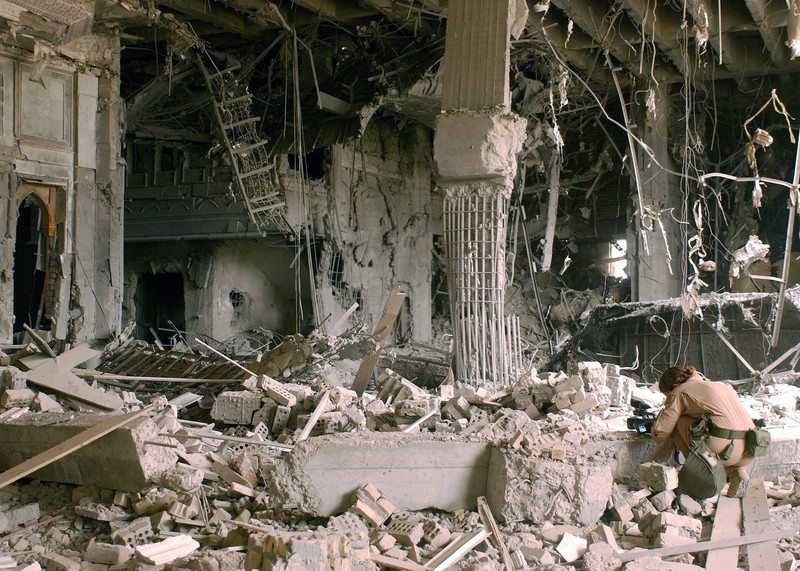
I met him in a room in Saddam’s Ba’ath Party Headquarters. Baghdadis called the building Qasr-al-nihayah - the castle of the end. It squatted like an angry potentate, scowling out over the oily filth of the Tigris. On its roof hunkered sandbags and machine guns on swivels, American soldiers lounging idly beside them.
Jagged cracks in the walls were the result of repeated attacks using Tomahawks and bunker busters in the early days of the war. There was a fifty-foot hole in the roof. A JDAM dropped by a B52 bomber had made its way down two floors before exploding. It was a miracle the building had survived.
The man I met was a General in the Iraqi Army. He had a request. To him it was a reasonable one. The kind made by a man who cares but daren’t show it. A man who long ago, through endless years of war and persecution and the tales of his father and his father before him, has understood that there were people with one purpose in life. To kill. Him, his wife, his children. His extended family if it came to that.
It was what the Sunni did to the Shi’a. It was a way of life. And now it was his turn.
The room was long and thin. Light came from a single neon tube hanging from the ceiling. It was devoid of windows, A door stood open in one wall. Beyond it the shadow of the general’s ever-watchful bodyguard, standing sentry under arc lights set high in the ceiling, darkened the floor. A small sofa and a dusty table stood on a rug at one end. The General sheltered behind a vast metal desk at the other. Two piles of papers had been placed on the desk. An in-pile and an out-pile. Between them lay four mobile telephones.
He stared at me for a moment. Then he pulled from his uniform jacket a packet of cigarettes. For a long moment he studied the pack, turning it this way and that between nicotine-stained fingers. Then, abruptly, he shook the cigarettes onto the table between the mobile phones. Carefully he selected one, placed it between his lips and, with a practiced movement, lit it with a match.
His eyes focused on the packet. He tore it open and flattened it on the desk, making space between phones and cigarettes. His fingers worked, concentration on his brow. He made a sort of a t-shape from its structured limbs. Then he pulled a biro from a collection in his breast pocket, lowered his head and wrote something. The pen moved in bold strokes on the unfolded carboard.
When he’d finished, he raised his head, fixed me with his eyes. In them I saw confidence. Perhaps disdain. He tossed the cardboard towards me. It slid towards the edge of the desk. I lunged forward but was too slow. The cardboard fell to the floor. I had to kneel to pick it up.
When I rose again, my eyes caught the remains of a quickly extinguished half-smirk.
I looked at the cardboard. Two groups of numbers. 8 digits in each. Coordinates. I recognised them. Hell, I even knew what was there.
I allowed myself a shake of the head. This would not do. Reverently I placed the unfolded packet back on his desk. Then I fixed my eyes on his. I hoped my expression was kindly.
“Sayeedee - Sir – the answer is no. This is not enough. We cannot help you with this.”
He froze.
Not dramatically. Not the way actors freeze. But there was suddenly a stillness. In the hands. The cigarette in his mouth did not move. Smoke trailed in lazy spirals towards the ceiling.
Finally he looked down. Stared blankly at the table for two seconds. When he looked up, he was not the man I was used to. In his eyes there was something new. Fear. And pleading. Lives were at stake. Lives belonging to those he loved. But he could not – or would not – do as we required. It was the end of the road.
For a moment longer he stared at me. Then he dropped the cigarette into the bucket by his chair, got wearily to his feet and left the office. His bodyguard followed him, a few regulation paces behind.
I never saw him again.
I have thought about that moment for years. Not about what it meant operationally. About what it told me about him. His offer had been careful, considered, the product of private calculation over a long period. In two seconds it had met something he had not accounted for. It had left him changed. In the space between the decision and the action, there was an entire interior life, and I had glimpsed one corner of it.
David Baboulene has a phrase for it. Character is not what a person tells you they will do. It is what they do when the plan meets the thing they had not anticipated. That gap, in fiction as in a borrowed room, is where a person is finally, unmistakably themselves.
Aristotle's progression gave me the architecture. The knowledge gap gave me the engine. Character gives me the people to put inside them.
In the book I am finishing, the character who frightens me most began in that room. Not in his appearance, not in his history. In the small, private movement of his hands.
More on that next time.
Yours sincerely,