
A story has to have a structure. A beginning, a middle, and an end. The cleverness – the joy of writing - is in the construction. Granting a reader his first awareness of a situation, teasing a realisation that all is far, far worse than at first looked to be the case. And then a climax, but not the one suggested, implicated by the story, somehow it is different. A twist, a surprise.
Aristotle’s peripeteia.
A girl’s nostrils wrinkle. It is familiar to her, this smell of death; the bodies reaching out from beneath the smashed houses in the searing heat of a Syrian summer.
She sneaks a look across the square. In the shade of an old terrace opposite where they stand a battered pick-up truck is parked. Someone has painted it in a sort of camouflage, great childish splashes of lurid brown and orange spread erratically over its bonnet and wings; belying the deadly intent of the machine gun mounted at its rear. Around it lounge men in black clothes, hanging lethargically over its roof and squatting on its load area. Under thick beards which curl to their chests are worn combat vests which sprout with hand grenades and magazines for the assault rifles which are never far from reach.
The men are dangerously idle, stupid with the heat. From beneath lowered brows they cast sinister glances towards the small group in which the children stand, just visible in the protective shelter of a rough mound of fallen rubble.
Yara and the twins hold third place in a queue leading to a large metal tank. It stands aloof on a scaffolding tower at one corner of a rubble strewn square, its red-painted flanks shining sleekly amongst the broken houses. On its side someone has pasted a label, the slender curving slash of the red crescent beside UNICEF’s blue and white. Another has painted the words “We drink, we live” in careful Arabic below the emblems, the letters crawling elegantly across the red metal.
Her stomach twists with fear when she looks at the fighters. They terrify her. They terrify them all. She remembers the streets of Aleppo from before. Snaking narrowly between tall buildings they were once a shaded refuge from the fierce sun, thronged with people going peaceably about their business. Western women colouring the scene with their bright clothes, young men sneaking glances at bare legs and arms. Taxis honking their horns and revving their engines, navigating between pairs of women clad head to toe in black. Battered lorries making deliveries to shops buried in the city’s ancient architecture, children darting from one place to another. Above them the ancient citadel gazing unwinkingly down at the hustle and bustle of daily life.
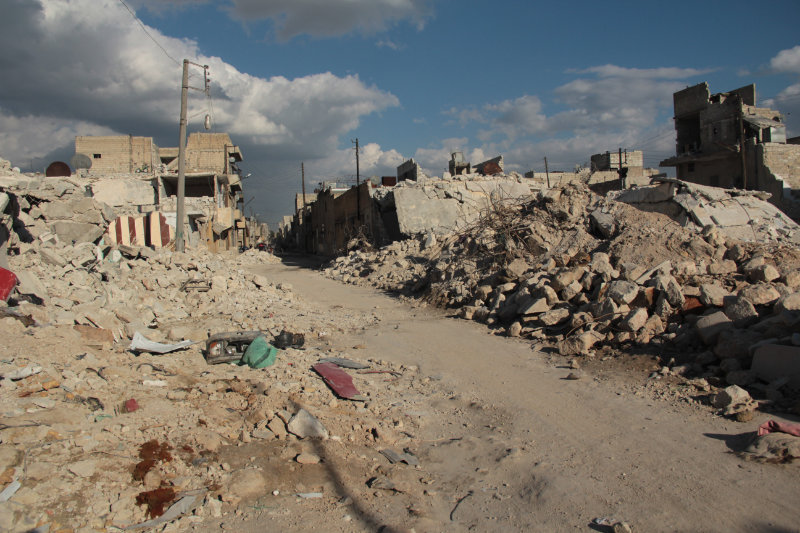
Now the narrow alleys cower wearily between jagged piles of broken yellow stones and the fallen timbers of once elegant buildings. A cloying, sickly odour hangs heavily in the oven-hot air, clinging to what is left of the city.
A gentle breeze fans the smell towards them, stroking the cheeks of the rubble. The clumps of tiny yellow flowers which swarm the ruins seem to shrink, shifting uneasily away from its touch. Beside it stands an old man, supervising the water issue. His hands hang motionless by his sides, the fingers gnarled and calloused from the rugs he has woven since boyhood. Like the city his hands are powerless, the life has fled from the fingers. A thin beard spreads across his chin, a scrub of unruly grey-white growth, a sheen of thin hair lies flat to his head above lines of worry deeply incised in his brow.
Yara is the eldest, she glances down at her brother and sister. The twins fidget beside her, they are just 8 years old. She lays a comforting hand on Hassan’s shoulder; it comforts her as well. Since the bombings began he has been nervous, apt to fall abruptly into uncontrollable tantrums, the fear leaving his small body as rage. She watches him, wonders what thoughts traverse his young mind. She herself lives in a state of permanent fear, they all do, she knows it. How can he possibly interpret his experiences? She squeezes his shoulder; he glances up at her and looks away. Nowadays he does not smile.
Although she has yet to see her twelfth summer Yara has the maturity of a much older child, She is tall, her long hair caught up behind her head in a band adorned with a bright pink plastic flower. The faded purple jogging trousers she wears over mismatched flipflops are already too short. She frowns slightly. Just last week they were fine. Under the threadbare flower patterned t-shirt her breasts are starting to swell with the approach of womanhood and hunger has shrunk her cheeks, losing something of the healthy roundness of childhood, giving her the appearance of a much older girl. Already she has noticed the strange new stares, the lingering glances from the few remaining men.
A hand tugs at hers; Amira jabs a small finger skywards. In the distance the steady clatter of a helicopter moves closer. They turn nervously towards the sound. Abruptly, the staccato of a machine gun answers, rudely interrupting the aircraft’s soundtrack. The clatter shifts, increases and then distances itself. There is a pause, then in rapid succession a handful of louder explosions. The children flinch, the ground shudders slightly, as if in distaste. The machine gun falls silent. The helicopter lingers a while, waiting for the answering riposte, then its heavy throbbing begins to recede, and is suddenly gone.
Yara shudders, the men terrify her. She has heard the stories which circulate about their behaviour, especially to girls who catch their fancy. Instinctively her shoulders hunch, lowering her chest beneath the threadbare t-shirt, shrinking herself inside it. Soon she too will wear the abaya, cover her hair and face like the older women. Not quite yet, she tells herself, be brave. The words of her father echo in her ears. “Do not look at them, whatever you do, keep your eyes down”.
A woman and a child appear suddenly in a dark opening amongst the stones. Like wraiths from a shadow world, they clamber blinking into the light. She holds tightly, desperately to the boy’s small hand. He stares wide eyed at the scene around him, hungry for stimulation. The cave-like basement from which they emerge is the family home. They share it with her husband and a second child. It has no water, electric light or any form of toilet. Above there are vacant rooms in the house they used to occupy, but it is safer to live below ground; it is the upper floors which keep them alive, providing a strange sort of layered protection from the bombs. Her husband spends his days scavenging for whatever he can lay his hands on. When he brings oil, she pours it gratefully into the tiny stove, careful to preserve every drop, and cooks what she can. Outside on a rare patch of scrubland not given over for use as a burial ground they grow a few herbs and vegetables. The weak, scrawny-looking plants are just enough to keep the children healthy. God knows what they will do if one of them falls ill.
The door from which they have emerged is a wooden square fashioned from debris to fill a gap between the stones. It closes loudly behind them. The men in the shade of the ivy-covered terrace turn to stare. The woman avoids their eyes, begins to cross towards the red tank. They too need water. In her free hand she grips a large plastic water container. Her robe too is long and black; it envelops her so completely that she seems to hover rather than walk. Invisible beneath it her paces are hurried, she focuses on the stony ground, her head bent towards the child at her side, whispering gentle encouragement.
Between her and the tank lies the large pile of rubble. A narrow path weaves around it, passing close to the lounging men and their vehicle. A metre close. Too close for comfort in this city of terror. She glances furtively in their direction. They stare back at her, their faces sullen and resentful.
She looks away, her eyes measure the pile of rocks; sees the marks of others forming the narrowest of paths around the side of the pile, just far enough from the men for safety. Her mind is made up. Unconsciously, as of habit, she releases the child’s hand and bends quickly to clutch a handful of the robe she wears, the better to negotiate the scramble ahead of them. The briefest flash of a pale ankle as they struggle over the unruly mound. A car headlight from the blackness of a distant mountainside. One flash and the light is gone. It happens so quickly the onlookers hardly have time to register it.
A ripple of anger runs through the men of the militia. Several pull themselves to their feet. One detaches himself from the group. He is a large man, heavy around the waist, lumbering with self-importance. He strides towards her, waving his assault rifle in the air, its strap swinging agitatedly below it. His voice is a scream of self-righteous fury, amplified by her fear. The woman cowers from him, one hand held high in self-defence. The child is silent, wide-eyed beside her. She shields his small body with her own. The man, still screaming, raises his rifle and brings it down on the woman’s head with such casual ferocity it will be a miracle if she survives. Her body, suddenly inert, falls to the ground.
A silence falls over the square. The man is breathing heavily; he stares at her body. Perhaps a brief pang of some deep-seated guilt grips him. Then, with a disdainful kick at her motionless form he spits and, for a moment, stares at the child. The onlookers hold their breath until, at last, his anger spent, he turns, strides back to his group.
For a second the child is frozen to the spot, uncomprehending. Then the wails begin to come, building rapidly to a crescendo of terror. Suddenly, to the surprise of the motionless onlookers, the woman moves, drags herself painfully to her feet. She reaches for the child and unsteadily, stumblingly, blood running from the wound to her head, she completes her passage across the rocks. A moment later they are gone, the errand forgotten. Behind her, the water container remains wedged in a cleft in the rocks. For the men standing by the pick-up truck it is as if nothing has happened.
The old man has not moved. Unbidden a fly alights on the rough skin of his cheeks, begins to navigate the uneven surface in enthusiastic darts. He seems unaware of its presence. His unwavering gaze is raised, fixed on the citadel above them. In its brooding presence he sees hope. Many times has the Citadel witnessed such evils; no doubt it will witness them again. The city - his city - will survive.
Yara forces her eyes away from the men by the truck. She stares fixedly at the ground by her feet, edges closer to her sister and brother. She bends to the twins, fixing them determinedly with her eyes, distracting them with words, stroking their hair.
Without thinking she talks, talks of their mother in happier times, before the war. Her small voice is measured, the tone quiet, just loud enough for the children to hear. It focuses their minds. She forces herself to be calm. The twins listen, gorging on the images they conjure.
At the front of their queue a small boy concentrates fixedly on the large plastic container between his feet. Suddenly, water begins to gush from its mouth around a length of black hose which leads from the red tank. It splashes cheerfully onto the ground. Quickly he jerks the hose away, twists a small tap, staunches the flow, straightens and hauls his container to a small trolley. In his wake he leaves a darkly muddy trail. With an effort he lifts it onto the metal frame of a narrow trolley, hooks a strap around it for security, grasps the trolley’s hooped handle and turns, his small frame leaning into his task. He struggles off, staring fixedly at the ground ahead of him, adroitly navigating the stones and debris on the path, his smooth young brow creased with the exertion.
The boy’s place is swiftly taken by three others. They are older; they push their wheeled trolley to the tank and with practised ease begin to fill and load their containers.
Yara stands patiently in line, she and the smaller children. The family’s weekly water requirement is critical to their survival. Though their father is strict about rationing its use this journey is still one the children make twice a week. Everyone has a trolley or a cart of some description. She envies those with wheels. And the bigger boys with the strength to transport more water. She looks down at their charge. It is a sort of plastic sled. It has no wheels, just skids which their father has taken from old garden chairs. Between the skids is fastened the door from a defunct refrigerator. Upon the door, where the narrow shelves had once carried cartons of fresh milk and other wonderful things she barely now remembers, are six large plastic water carriers. They fit neatly into the gaps between the shelf mountings.
The boys, their containers now brimming, move off, leaving a trail of spilt water behind them. Yara picks up a thick rope attached to the front of the cart. Hassan and Amira, her twin brother and sister, bend to help. Their father has made the sledge. It is the door of a refrigerator, attached to makeshift skids fashioned from plastic garden chairs. A rope is attached to one end.
The sledge slides scratchily towards the filling point. The old man’s mouth twitches uneasily into what might have been a crooked smile and leans down to lift the first of her precious containers towards the length of hose attached to the tank. Rapidly, the children begin to work. Yara fills and Hassan and Amira drag the heavy containers onto the sledge. They are quickly done. She smiles at the old man and together they begin to manoeuvre the sledge back the way they have come.
The flat, crack-whip sound of a rifle shot rings out. The double noise overlaps itself. The children know the different sounds made by bullets. The noise above their heads signifies danger. Now that the bombing has reduced the buildings to street level they are desperately exposed to the regime’s snipers in their eyries in the tall buildings of the City’s wealthy west. There, where mirrored glass windows glitter and shimmer in the midday sun, snipers lie motionless, picking off targets indiscriminately. Men, women and children, none are spared.
More shots, they lower their heads, move a little faster, the noise made by the cart amplified slightly by the increased speed. Yara is frightened, she urges the twins to greater speed. She knows they are out of sight of the snipers and yet nowhere here is entirely safe. Her mind is desperately focused on the relative safety of home. Their path is circuitous, the children must manhandle the awkward sled around tight bends and over piles of debris. People in the city have ceased to follow the old streets. The paths that have emerged in their place wind their way between intersecting areas of cover; between overturned buses and wrecked cars and behind tall mounds of rubble surreptitiously erected by the few remaining menfolk in the dark of the night to shield them from the watchful snipers’ eyes. People move between them in a strange bobbing rhythm, their heads held low, their pace accelerating from a fast walk to short sprints in those areas more exposed than others.
She closes her mind to all but the task in hand, bends her head to the weight of the sled and its load. The responsibility for the water and the younger children is hers and hers alone. She wants desperately to be at home. Inside the tall, bright green door which marks out her house from the others. Home where there is a measure of safety at least. Hassan and Amira follow her example. The skids of the sledge begin to shriek on the broken surface. The roar of a jet shatters the silence. There is a muffled series of distant explosions, one follows another, three in rapid succession. Above them tiny dots trace a leisurely path across the sky. The rubble around them shakes, forces dust into the air. The echoes of the explosions fade, but the roar of the jet on a second pass quickly replaces them. The children barely notice.
It is more than half an hour of pushing, pulling, hauling the sledge and its treasured contents along labyrinthine tracks thick with dust. It is hot, hard work.
At last, their faces lined with the sweat that has forged channels through the fine dust on their cheeks, the children round a corner. Yara’s eyes search eagerly for the comforting safety of the house. She straightens, frowns. It is not what she has expected. Her eyes come abruptly to rest on a layered pile of fallen rubble, a once elegant townhouse in a street of many, the crushed aftermath of the aircraft’s bombs.
All around lies the debris of the explosion, making of the street an assault course of rough obstacles. The contents of a household lie scattered in what is left of the street; items of clothing, a child’s shoe, a right angle of dark polished wood, perhaps once a drawer. Next to it a coloured plastic box, somehow intact, balanced atop a mound of loose stone. Everywhere lie piles of rocks in all shapes and sizes, outlines softened by the thick air. A door, apparently freshly painted, bright with green paint, hangs from its frame, twisted by the weight of the building above.
Around it a crowd of bystanders has gathered. Some merely stand, their faces blank with shock, staring hopelessly at the pile of rocks before them. Others clamber frantically around the rubble, shouting, calling for help, straining at great pieces of stone.
Yara feels the panic begin to rise, the tears forming in her eyes. Her hands flee to her mouth. Then she glances down to her brothers, reaches for them, instinctively draws them to her. They are shocked, uncomprehending. The sledge and its precious contents are forgotten.
An ambulance stands to one side. The vehicle’s sides are striped with the red and black of the Syrian flag. Above the stripes, the yellow and blue emblem of the Syrian Civil Defence Force shows proudly alongside the Arabic word for ambulance. Within the emblem is a dark blue outline of the Syrian land mass; a picture of the group’s famous white helmet etched in its centre. On its roof blue lights flash desultorily, as if they have seen it all before.
A tall man stands beside the ambulance. The sand-coloured uniform he wears lends him an air of authority. On his white plastic helmet sits a powerful head torch, a gift from the UN. Attached to a clip at his chest is a radio and at his elbows and knees thick pads protect him from the sharp edges of fallen stone. Behind him others are moving, pulling on masks, aluminium stretchers bumping erratically behind them.
The tall man approaches, lays a gentle hand on Yara’s shoulder. She glances up at him. He sees the fear in her eyes. Her hands fidget nervously. She raises a fearful finger, holding it close to her body, pointing dazedly at the rubble that once had been her home.
“My family.” She mutters. “My parents…” her small voice tails off. She stops, her eyes swivel back towards the green door. Her mouth hangs open, her eyes move slowly, pupils wide. The man squeezes her shoulder gently. He feels her pain. It is familiar to him, this pain. For him it is a daily occurrence. So many orphaned children. Children wrenched bodily from the support they needed to survive in a world robbed of order, of kindness. Brutalised by powers outside their control, powers that cared nothing for their tiny, struggling existences. Inwardly he shrugs. He will do what he always does. There is a charity that takes care of such children, transports them to safety in orphanages in neighbouring countries. Jordan, Lebanon. He cannot replace their families, their homes. But it is better than the life they will otherwise inherit. Starvation and abuse at the hands of those who deal in such things.
The man’s eyes stray to the rubble. He is experienced in these matters. He knows that the efforts his team make here are futile. The bomb has been a direct hit. The chances of finding a survivor are infinitesimal. He eyes his team, already working in the wreckage. Their equipment is primitive, much of it hand made. The time it took to extract a survivor without the heavy lift machines they so sorely need means that anybody they do extract was usually dead by the time they reached them. He dismisses the thoughts, it does no good to dwell. All they can do is try. He reaches into his overalls and lifts a mobile phone from a pocket, examines the screen.
Suddenly there is a cry. A light flashes in the girl’s eyes.
“Yara! Children!”
She turns. An older couple are moving slowly towards them, the man limping heavily, his arm about the shoulders of his wife. She feels the boys exclaim beside her, begin to pull away from the tightness of her clasp. Even at a distance they are a familiar sight. Suddenly the three children are running, pell mell towards their parents.
The tall man looks on. He smiles, replaces the phone in his pocket. Today, he tells himself, will be a good day. Then he turns and strides to the wreckage of the building. There is still work to do.
Yours sincerely,